
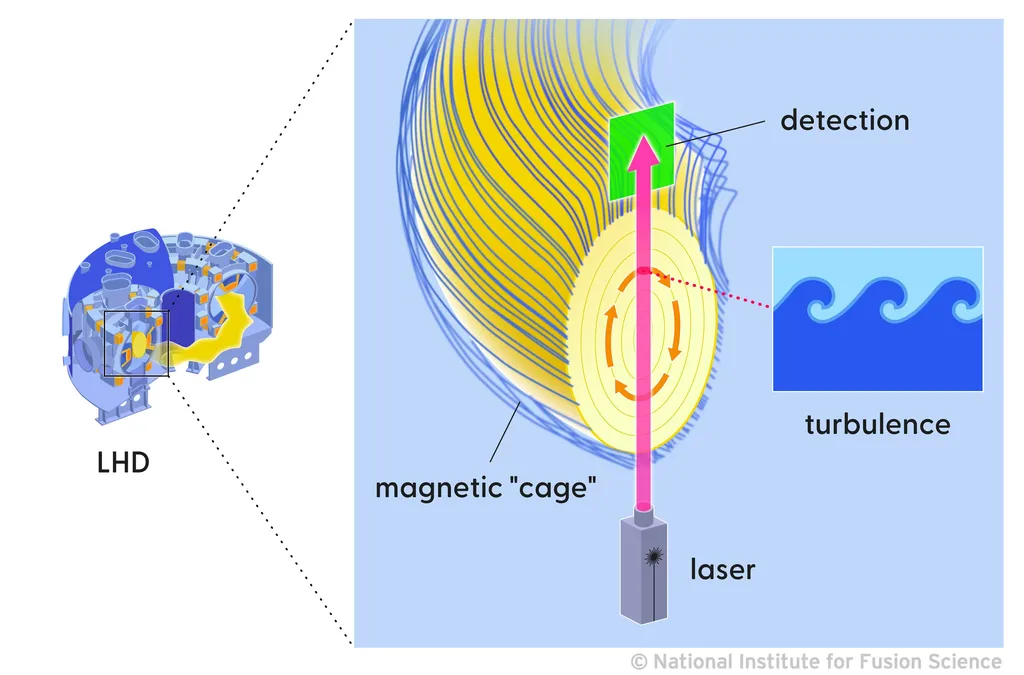
Researchers from the University of Oxford, the University of Toronto, Culham Centre for Fusion Energy, and the Max Planck Institute for Plasma Physics have made significant strides in understanding turbulent transport in magnetized fusion plasmas. Their work, published in the journal Nature Physics, offers a new theoretical framework that could enhance predictive modeling for fusion reactor design.
Turbulent transport is a major challenge in achieving efficient magnetic confinement in fusion devices. Two primary drivers of this turbulence are microscale instabilities fueled by electron- and ion-temperature gradients (ETG and ITG). These instabilities determine the cross-field transport of particles and energy, which is crucial for the efficiency of fusion reactions. However, predicting this turbulence has been difficult, relying either on expensive gyrokinetic simulations or reduced models calibrated to numerical or experimental data.
The researchers developed a simple asymptotic scaling theory that unifies ETG- and ITG-driven turbulence within a common framework. By balancing the fundamental time scales of linear growth, nonlinear decorrelation, and parallel propagation, the theory identifies the dependence of the heat flux on equilibrium parameters to two key quantities: the parallel system scale and the outer-scale aspect ratio. These quantities encapsulate the essential physics of saturation, leading to distinct predictions for ETG and ITG transport.
The theory predicts a cubic scaling with the temperature gradient in the electron channel and a linear scaling in the ion channel. Extensive nonlinear gyrokinetic simulations confirmed these theoretical predictions, demonstrating their validity across different magnetic geometries, including slab, tokamak, and stellarator configurations. This marks the first numerical confirmation of the cubic ETG scaling anticipated by earlier theories.
By isolating the dependence on just the parallel system scale and the outer-scale aspect ratio, this framework provides a physics-based foundation for fast, geometry-aware transport models. This advancement offers a pathway toward reactor optimization in both tokamaks and stellarators, potentially accelerating the development of practical fusion energy solutions.
The research was published in the journal Nature Physics, providing a significant contribution to the field of fusion energy research.
This article is based on research available at arXiv.