
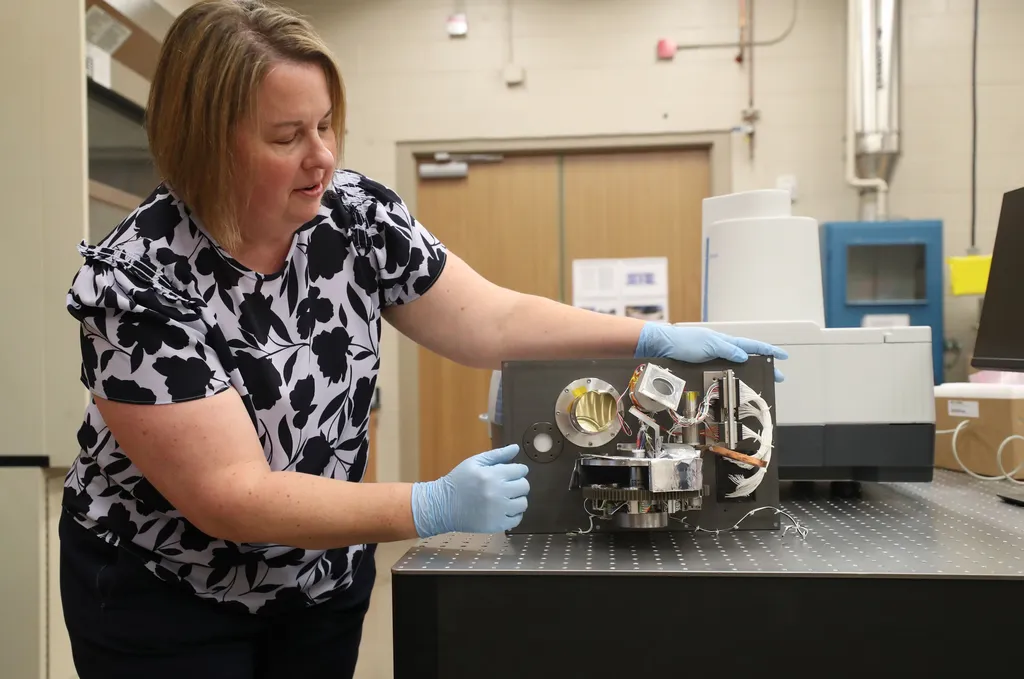
In the realm of energy journalism, a team of researchers from the University of Central Florida has been delving into the intricacies of lunar regolith, the layer of loose, heterogeneous superficial deposits covering lunar solid bedrock. Their work, published in the journal “Advances in Space Research,” focuses on understanding the physicochemical properties of lunar regolith simulants to optimize in situ oxygen production, a critical factor for sustainable lunar settlements and space exploration.
The team, comprising Alyssa Ang De Guzman, Anish Mathai Varghese, Saif Alshalloudi, Lance Kosca, Kyriaki Polychronopoulou, and Marko Gacesa, has been working to validate and characterize high-fidelity lunar regolith simulants. These simulants are designed to mimic the lunar highlands and south pole, regions of particular interest for future lunar missions.
The researchers employed a suite of analytical techniques, including scanning electron microscopy with energy-dispersive X-ray spectroscopy, X-ray diffraction, and Brunauer-Emmett-Teller surface area and pore structure analysis. They also utilized hydrogen temperature-programmed reduction to study the reduction behavior of the simulants. Their findings revealed that the simulants exhibit strong mineralogical and compositional fidelity to returned Apollo and Chang’e samples. Notably, ilmenite, a mineral containing iron, titanium, and oxygen, was confirmed as the most readily reducible oxygen-bearing phase.
However, the team discovered that despite the low abundance of ilmenite in the highland simulants, these materials displayed favorable reduction behavior. This behavior arises from the presence of distributed iron-bearing silicate and glassy phases, as well as surface and microstructural properties that influence gas-solid interactions. Adsorption experiments with gases like hydrogen, methane, and carbon dioxide, as well as water, indicated that mineralogical heterogeneity and pore accessibility significantly influence gas uptake in the simulants.
The implications of this research for the energy sector, particularly in the context of space exploration and colonization, are substantial. Efficient oxygen extraction from lunar regolith is crucial for life support and propulsion systems in permanent lunar settlements. The findings suggest that whole-regolith processing strategies, rather than focusing solely on ilmenite content, could be more effective for oxygen production. This approach could pave the way for more sustainable and self-sufficient lunar missions, reducing the need for Earth-based supplies and enhancing the viability of long-term space exploration.
In summary, the work of De Guzman and her colleagues provides valuable insights into the physicochemical properties of lunar regolith simulants, highlighting the importance of considering the whole-regolith response for efficient oxygen extraction. This research not only advances our understanding of lunar materials but also offers practical applications for the energy sector, particularly in the realm of space resource utilization.
Source: Advances in Space Research, Volume 70, Issue 1, July 2022, Pages 1-15.
This article is based on research available at arXiv.