
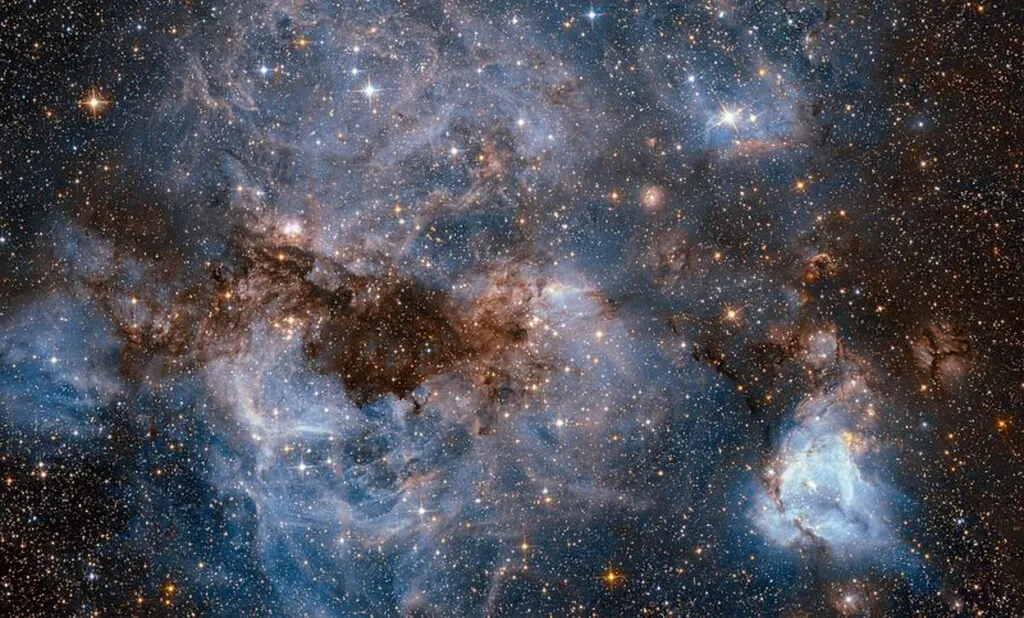
In the realm of energy and astrophysics, understanding the dynamics of star-forming regions can provide valuable insights into the processes that govern the evolution of our universe. Researchers from the Observatoire de la Côte d’Azur and Aix Marseille Université in France, including D. Russeil, H. Plana, P. Amram, A. Zavagno, and F. Michel, have recently published a study in the journal Astronomy & Astrophysics that delves into the kinematics of the HII region NGC 7538.
The study aims to shed light on how massive stars influence their surroundings and initiate star formation along their photo-dissociation regions. Once an HII region is formed, it is unclear how subsequent generations of stars impact its appearance and evolution. To address this, the researchers performed high spectral resolution observations of the Ha line in five fields covering the Galactic HII region NGC 7538 using a Fabry-Perot interferometer. They then analyzed the kinematics of the ionized gas by building kinematic diagrams and second-order structure functions for each field.
The observations revealed a general blue-shifted ionized gas flow larger than 11 km/s in NGC 7538, consistent with previous studies. Profiles originating from features that are dark in Ha due to extinction or from outside the region showed velocity dispersion larger than that typically found for the Warm Interstellar Medium. The analysis of kinematic diagrams and second-order structure functions revealed non-thermal motions attributed to turbulence and large-scale velocity gradients. In the direction of the HII region itself, the turbulence seems to be shock-dominated, with a characteristic scale length between approximately 0.72 and 1.46 parsecs.
In this context, the researchers propose that the kinematics of the central part of the region could be explained by the superposition of the outflow coming from IRS1 and a wind bow shock formed ahead of IRS6. This study provides valuable insights into the complex dynamics of HII regions and the role of massive stars in shaping their surroundings. Understanding these processes can have practical applications in the energy sector, particularly in the development of nuclear fusion technologies, as the conditions in HII regions can mimic those found in fusion reactors.
The research was published in the journal Astronomy & Astrophysics, providing a foundation for further exploration into the kinematics of star-forming regions and their implications for energy research.
This article is based on research available at arXiv.