
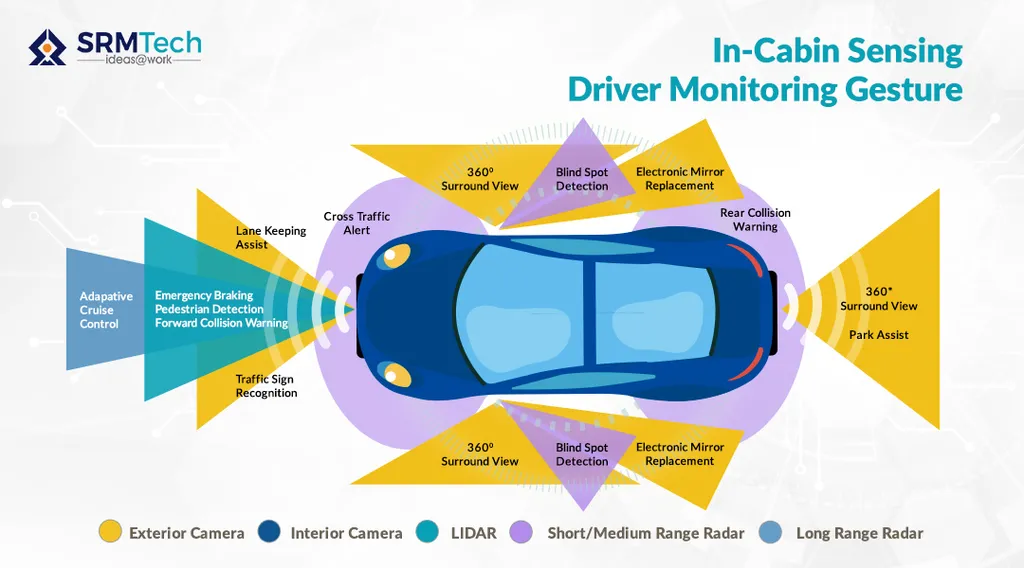
In the realm of autonomous vehicles and advanced driver-assistance systems, ensuring safety and reliability is paramount. Researchers like A. Enes Doruk from the University of California, Berkeley are at the forefront of developing technologies that address these challenges. Their recent work focuses on improving the way autonomous vehicles perceive and interpret their surroundings, a critical aspect for safe navigation.
The research addresses the shift from sparse object detection to dense 3D semantic occupancy prediction, which is essential for handling complex and dynamic environments. Current methods often struggle with high computational demands and difficulties in fusing data from different sensors, such as cameras and LiDAR. To tackle these issues, the study introduces a novel Gaussian-based adaptive multi-modal 3D occupancy prediction model. This model integrates the semantic strengths of camera data with the geometric precision of LiDAR data, using a memory-efficient 3D Gaussian model.
The proposed solution consists of four key components. First, LiDAR Depth Feature Aggregation (LDFA) employs depth-wise deformable sampling to manage geometric sparsity, ensuring that the LiDAR data is accurately interpreted despite its sparse nature. Second, Entropy-Based Feature Smoothing uses cross-entropy to handle domain-specific noise, improving the robustness of the data fusion process. Third, Adaptive Camera-LiDAR Fusion dynamically recalibrates sensor outputs based on the model’s predictions, allowing the system to adapt to changing environmental conditions. Finally, the Gauss-Mamba Head utilizes Selective State Space Models for global context decoding, achieving linear computation complexity, which makes the system more efficient and scalable.
For the energy sector, particularly in the development of electric and autonomous vehicles, this research offers practical applications. By improving the accuracy and efficiency of 3D semantic occupancy prediction, autonomous vehicles can navigate more safely and effectively, reducing the risk of accidents and enhancing overall performance. This, in turn, can accelerate the adoption of autonomous vehicles, contributing to the broader goals of reducing carbon emissions and improving energy efficiency in transportation.
The research was published in the IEEE/RSJ International Conference on Intelligent Robots and Systems (IROS), a leading venue for robotics research. The findings highlight the potential for advanced sensor fusion techniques to revolutionize the way autonomous vehicles perceive and interact with their environment, paving the way for safer and more reliable transportation systems.
This article is based on research available at arXiv.