
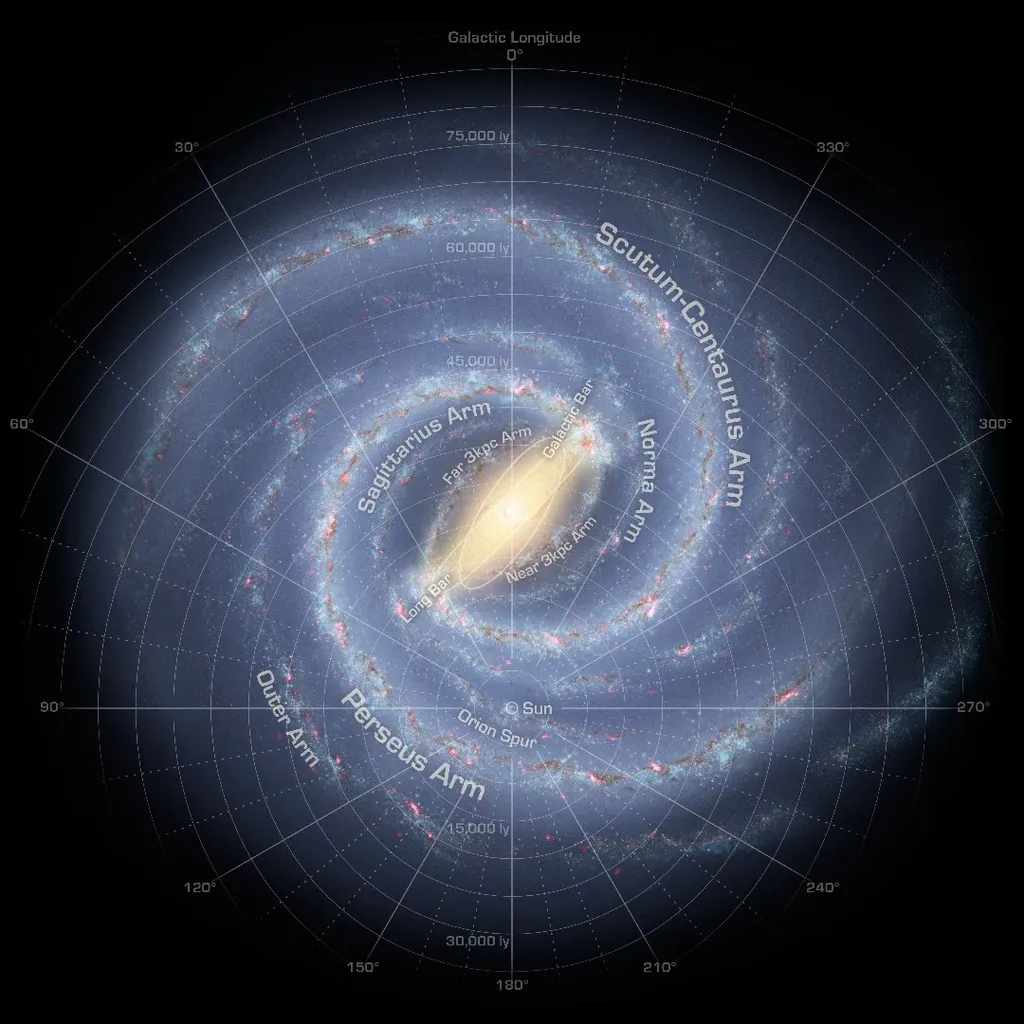
In a recent study led by Mika Lambert from the University of Toronto, a team of researchers has shed new light on the dynamic interactions within our Milky Way galaxy, with potential implications for understanding the broader universe and even our own solar system’s energy dynamics. The team, which includes members from various institutions such as the University of California, Berkeley, and the University of Michigan, utilized data from the Dark Energy Spectroscopic Instrument Milky Way Survey (DESI MWS) to examine the anticenter region of the Milky Way’s stellar disk.
The researchers focused on two well-known stellar overdensities in the anticenter: the Monoceros Ring (MRi) and the Anticenter Stream (ACS). By analyzing the kinematics of these regions using 61,883 main sequence turn-off stars, they discovered that the MRi overdensity exhibits kinematics consistent with a tidally induced spiral arm. This type of spiral arm is created by the gravitational interaction with a satellite galaxy, which in this case is most likely the Sagittarius Dwarf Spheroidal galaxy (Sgr). The team calculated that the two most recent passages of Sgr occurred approximately 0.25 and 1.10 billion years ago.
The study also confirmed that the ACS is kinematically decoupled from the MRi, as they are moving in opposite radial and vertical directions. Interestingly, the researchers found that the kinematics associated with the ACS are not confined to the defined overdensity. Instead, the features observed in the ACS region are likely part of a broader distribution of stars sharing the same kinematic signature, similar to those detected in other areas like the vertical wave in the outer disk and phase spiral.
For the energy sector, understanding the dynamic interactions within our galaxy can have practical applications. For instance, the gravitational interactions that create tidal forces can influence the distribution and behavior of dark matter, which in turn affects the overall gravitational potential of the galaxy. This knowledge can help refine models of galactic dynamics and improve our understanding of the universe’s energy landscape. Additionally, studying the kinematics of stellar populations can provide insights into the formation and evolution of galaxies, which can have implications for the energy processes involved in star formation and galactic evolution. The research was published in The Astrophysical Journal.
This article is based on research available at arXiv.