
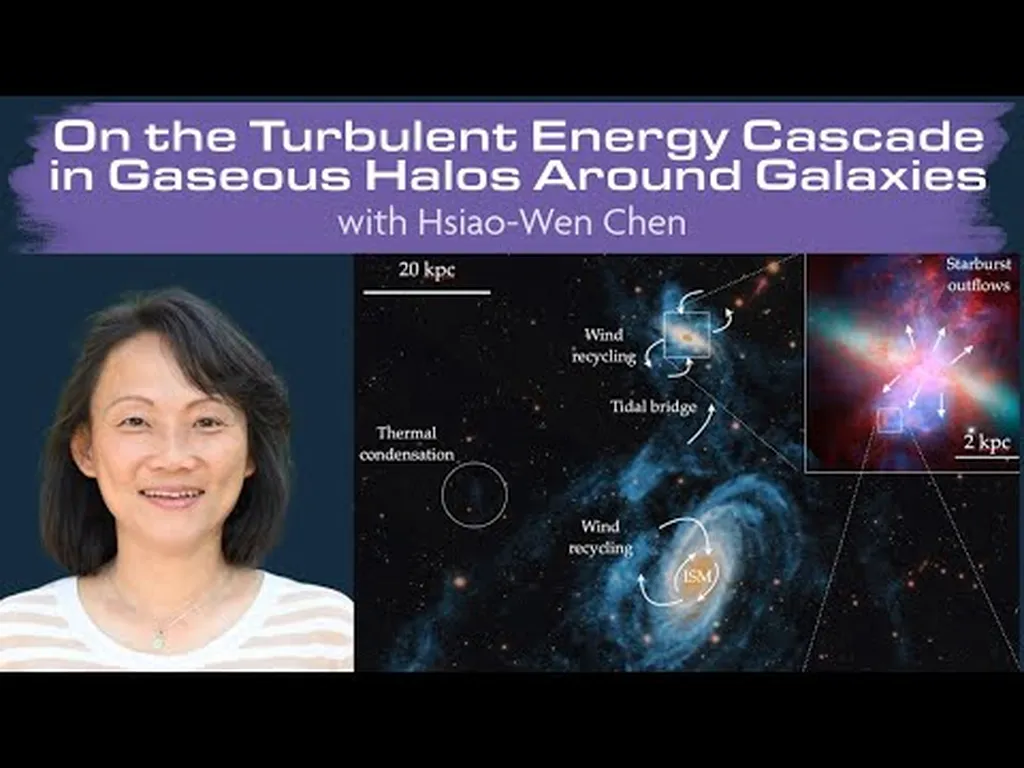
In the realm of energy journalism, Itzhak Goldman, a researcher from the University of Haifa in Israel, has recently made significant strides in understanding the dynamics of turbulence within star-forming galaxies. His work, published in the Astrophysical Journal, offers insights that could have practical applications for the energy sector, particularly in the realm of astrophysical energy processes.
Goldman’s study focuses on a star-forming galaxy located approximately 10.4 billion light-years away, observed as it was when the universe was about 3 billion years old. This galaxy exhibits both large-scale and small-scale turbulence, driven by different mechanisms. The large-scale turbulence, with a spatial scale of about 6.4 kiloparsecs (kpc), is likely generated by gravitational interactions or mergers with other galaxies. This turbulence has a timescale of around 500 million years, indicating that the process has been ongoing for a considerable period.
On the other hand, the galaxy also shows evidence of small-scale turbulence. The largest spatial scale for the nebular gas velocity field is about 240 parsecs (pc), while for the outflowing wind velocity field, it is around 290 pc. These smaller scales of turbulence are likely driven by intense star formation activity within the galaxy. Specifically, stellar sub-clumps or giant star clusters with a high concentration of young, massive stars could be responsible for both the outflow and the small-scale turbulence.
The practical implications for the energy sector lie in understanding the mechanisms of energy transfer and dissipation in astrophysical environments. Turbulence plays a crucial role in the dynamics of interstellar medium (ISM) and star formation, which are fundamental processes in the lifecycle of galaxies. By studying these phenomena, researchers can gain insights into the efficiency of energy conversion and the feedback processes that regulate star formation and galaxy evolution.
Moreover, understanding the drivers of turbulence can help in modeling the energy output and feedback mechanisms of star-forming regions. This knowledge can be applied to improve simulations of galaxy formation and evolution, which are essential for predicting the energy output and distribution within galaxies. Such insights can also inform the development of energy technologies that harness astrophysical processes, such as fusion energy research.
In summary, Goldman’s research provides a detailed analysis of the turbulence within a star-forming galaxy, highlighting the different scales and drivers of these turbulent processes. The findings offer valuable insights into the energy dynamics of galaxies and have potential applications for the energy sector, particularly in the fields of astrophysical energy processes and fusion energy research.
This article is based on research available at arXiv.