
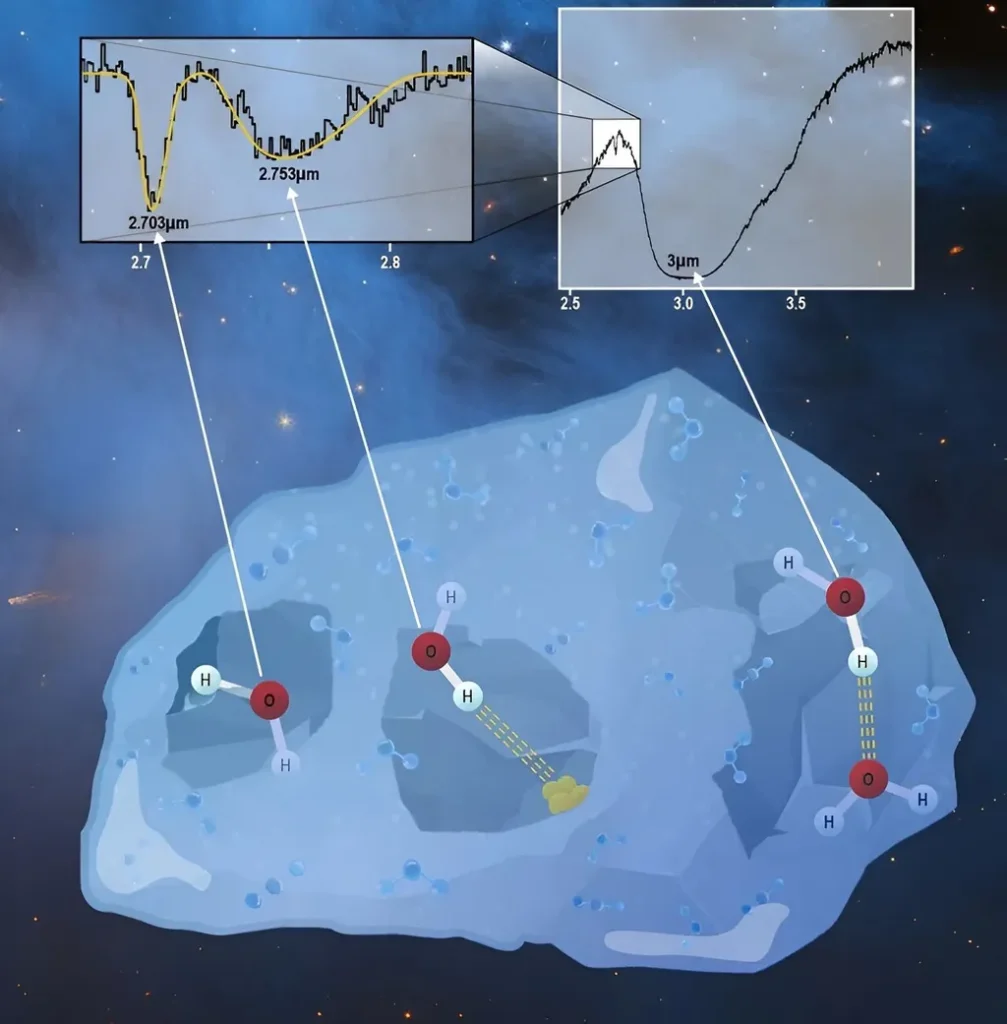
In the realm of astrochemistry and energy research, a team of scientists from the INAF-Osservatorio Astronomico di Cagliari and the University of Cagliari in Italy, along with a collaborator from the Leibniz-Institut für Astrophysik Potsdam in Germany, has delved into the intricate world of molecular diffusion on interstellar ice surfaces. Their study, published in the journal Physical Chemistry Chemical Physics, sheds light on the behavior of carbon monoxide (CO) on amorphous solid water (ASW), a common component of interstellar ices.
The researchers, Francesco Benedetti, Mauro Satta, Tommaso Grassi, Stefan Vogt-Geisse, and Stefano Bovino, employed advanced quantum-chemical methods to model the diffusion dynamics of CO on ASW surfaces. By using an ensemble of water clusters, each consisting of 22 molecules, they computed the diffusion energy barriers between binding sites using Density Functional Theory. This approach allowed them to determine diffusion rate coefficients by applying the harmonic approximation of Transition State Theory.
The study revealed a wide distribution of diffusion energies, reflecting the topological heterogeneity of ASW surfaces. This finding underscores the significant influence of surface mobility on CO’s desorption dynamics and, consequently, on surface-mediated reactivity in interstellar environments. The researchers emphasize that key parameters commonly used in astrochemical models, such as the ratio between binding and diffusion energy, should be carefully revisited in light of these new insights.
For the energy sector, understanding the surface chemistry of interstellar dust grains can have practical applications in the development of advanced materials for energy storage and conversion. The insights gained from this study can inform the design of more efficient catalysts and adsorbents, which are crucial for processes such as carbon capture and storage, as well as the production of synthetic fuels. Additionally, the methods and findings from this research can contribute to the broader field of materials science, where surface diffusion and reactivity play pivotal roles in various energy-related technologies.
In summary, the research conducted by Benedetti and his colleagues provides valuable insights into the fundamental processes governing molecular diffusion on interstellar ice surfaces. These findings not only advance our understanding of astrochemistry but also hold promise for practical applications in the energy sector, particularly in the development of advanced materials for energy storage and conversion.
This article is based on research available at arXiv.