
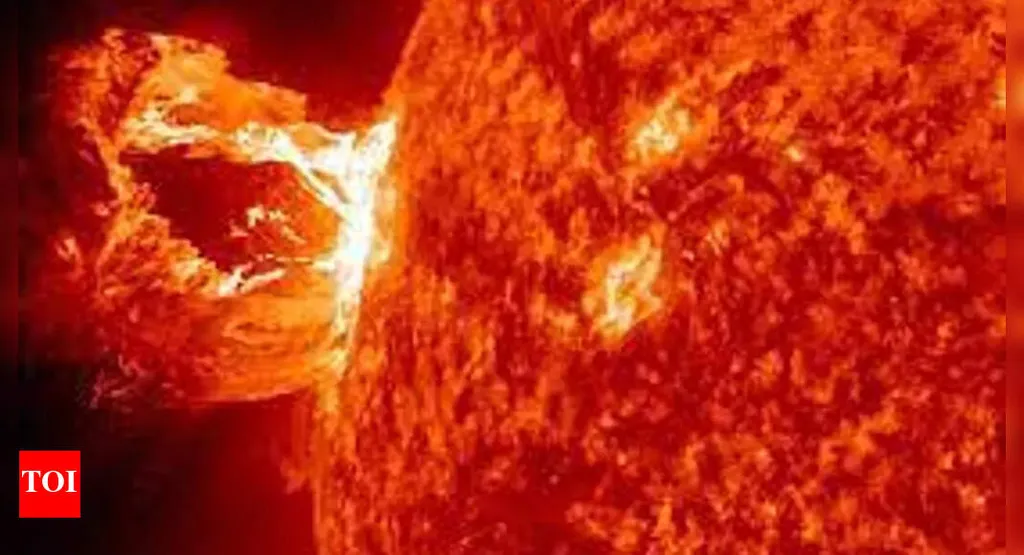
Researchers from the Indian Centre for Space Physics, including Sourav Palit, Subhajit Bhattacharyya, Taraknath Bera, and Sandip K. Chakrabarti, have conducted a study that explores the impact of solar flares on Very Low Frequency (VLF) radio waves, which has implications for understanding and predicting space weather events that can affect energy infrastructure.
The Earth’s ionosphere, a layer of the upper atmosphere, is constantly influenced by ionizing radiation from the Sun, including extreme ultraviolet (EUV) and X-rays. During solar flares, these emissions can cause sudden ionospheric disturbances (SIDs) that affect the propagation of VLF radio waves. These waves, which are used for long-distance communication and navigation, travel between the Earth’s surface and the ionosphere. Changes in the ionosphere’s electron density, driven by solar activity, can alter the path and strength of VLF signals.
In previous work, the researchers developed a model to simulate the deviation in VLF amplitude caused by different classes of solar flares. This model combined Monte Carlo simulations to calculate the rate of ionization, ion-chemistry evaluations to assess plasma density enhancement, and radio propagation simulations. In their current study, published in the journal “Advances in Space Research,” the team aimed to reconstruct the modulation of VLF signals over a single day when multiple solar flares occur. By successfully simulating the complex scenario of multiple flares, the researchers demonstrated the accuracy of their understanding of how solar activity affects the lower ionosphere.
This research has practical applications for the energy sector, particularly in improving the resilience of power grids and communication systems to space weather events. Solar flares and other forms of solar activity can induce geomagnetic disturbances that can disrupt power grids, damage transformers, and cause widespread blackouts. By better understanding and predicting these events, energy providers can take proactive measures to protect their infrastructure and ensure reliable energy delivery. Additionally, the study’s findings can enhance the accuracy of VLF communication systems, which are used in various industries, including aviation, maritime navigation, and emergency services.
The researchers’ work highlights the importance of continuous monitoring and study of the ionosphere to better predict and mitigate the impacts of space weather on critical infrastructure. As our reliance on technology and interconnected systems grows, the need for robust space weather forecasting becomes increasingly vital for maintaining the stability and security of global energy systems.
This article is based on research available at arXiv.