
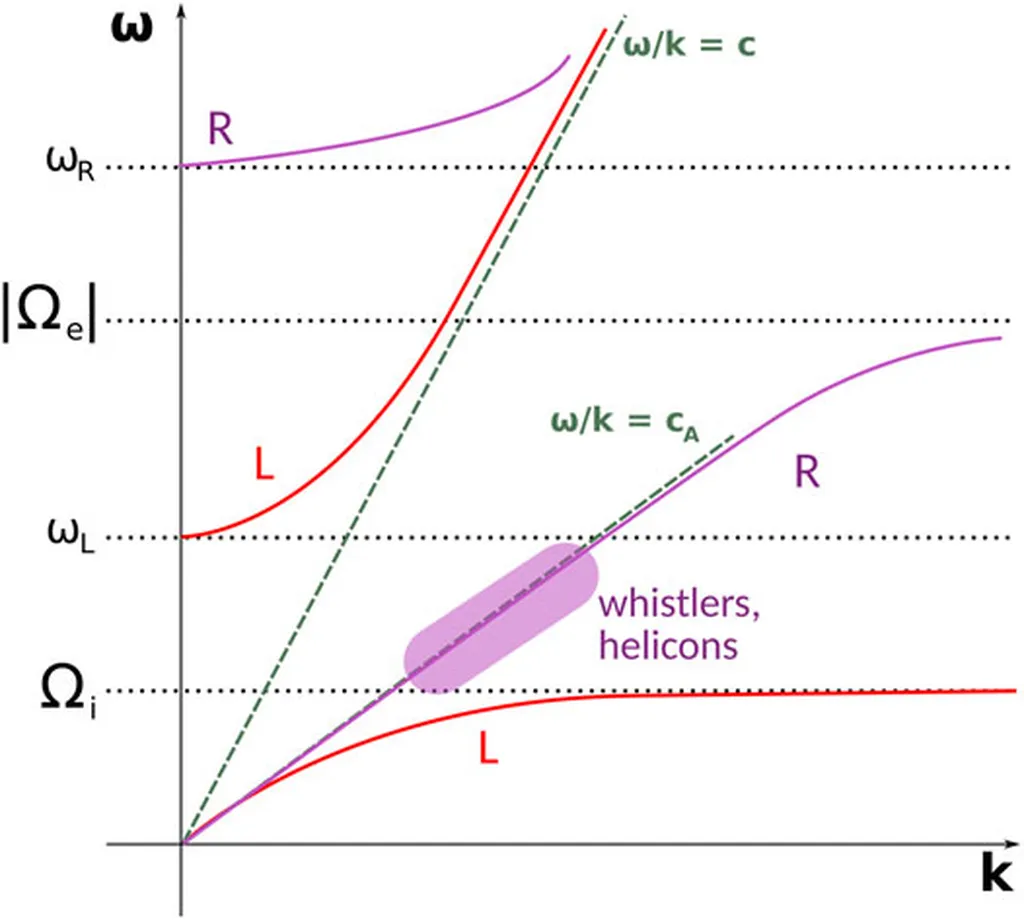
In the realm of energy research, a team of scientists led by A. Kumar from the Oak Ridge National Laboratory, along with collaborators from various institutions, has been investigating the interaction between high-power helicon waves and plasma-facing materials in the DIII-D tokamak, a magnetic fusion device. Their findings, published in the journal Nuclear Fusion, shed light on the challenges and potential implications for future fusion reactors.
The researchers focused on the plasma-material interaction (PMI) challenges posed by the high-power helicon wave system in the DIII-D tokamak. This system introduces complex dynamics due to rectified radio frequency (RF) sheath potentials forming near antenna structures and surrounding tiles. To understand these interactions, the team employed the STRIPE modeling framework, which integrates several sophisticated simulation tools to model carbon erosion, re-deposition, and global impurity transport.
The team’s simulations revealed that rectified sheath potentials of 1-5 kV form near the bottom of the antenna, where magnetic field lines intersect at grazing angles. Carbon erosion was found to be dominated by carbon self-sputtering, with RF-accelerated deuterium ions (D+) contributing up to 1% of the total erosion flux. The study compared two scenarios: a small-gap and a large-gap case between the antenna and the plasma. In the small-gap case, only about 13% of the eroded carbon was re-deposited locally, with 58% transported into the core plasma. In contrast, the large-gap case exhibited lower total erosion, reduced core penetration (about 35%), and weaker re-deposition (about 4%), consistent with lower collisionality and limited plasma contact.
These findings are consistent with experimental observations, which have not shown elevated core impurity levels during helicon operation in the current graphite-wall configuration of the DIII-D tokamak. However, the researchers caution that under certain plasma conditions and magnetic configurations, the helicon antenna may still act as a finite source of net erosion and core-directed impurity transport. This could potentially influence the overall core impurity balance, a critical factor in the performance of fusion reactors.
The study emphasizes the need for sheath-aware antenna designs and predictive impurity transport modeling to support future high-power RF systems. This is particularly relevant for fusion devices with high-Z (high atomic number) first wall materials, which are being considered for next-generation fusion reactors. By understanding and mitigating these PMI challenges, researchers can help pave the way for more efficient and sustainable fusion energy solutions.
The research was published in the journal Nuclear Fusion, a leading publication in the field of plasma physics and fusion research. The findings contribute valuable insights to the ongoing efforts to harness fusion energy, a potentially abundant and clean energy source for the future.
This article is based on research available at arXiv.