
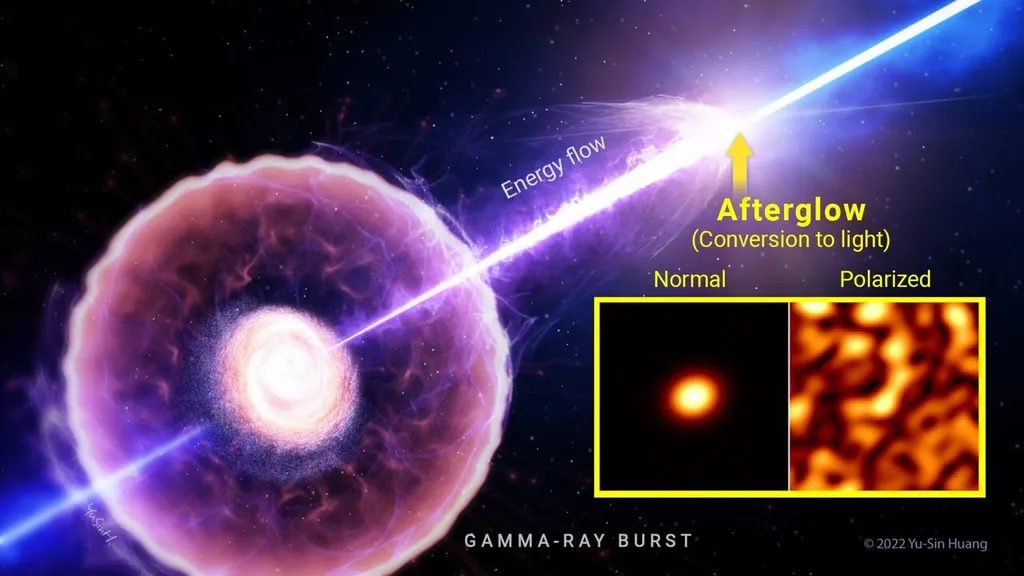
Researchers from the Gran Sasso Science Institute, the National Institute for Astrophysics (INAF), and the University of Insubria in Italy, along with collaborators from the University of Calcutta in India, have published a study in the Astrophysical Journal that explores the interaction of gamma-ray bursts (GRBs) with their surrounding environment. The team, led by Gor Oganesyan, investigates how these interactions can provide insights into the progenitor stars of GRBs and their mass loss processes.
Gamma-ray bursts are intense explosions of energy that are thought to be associated with the collapse of massive stars or the merger of compact objects. As the relativistic jets from these bursts escape, a small fraction of X-ray photons are scattered by electrons in the circumburst medium. This scattering leads to the generation of electron-positron pairs through photon-photon absorption between the incoming MeV gamma-rays and the back-scattered X-rays. The researchers studied how these back-scattered photons modify the prompt GRB spectrum through gamma-gamma absorption.
In a dense and pair-loaded wind environment, the emerging spectra exhibit a broad attenuation structure. The morphology of this structure is sensitive to the low-energy spectral index alpha. Notably, spectra with alpha greater than -1 develop a pronounced, saddle-shaped absorption between 1 and 100 MeV in the rest frame. This external MeV absorption could explain the spectral curvature observed in some bright GRBs.
The findings suggest that the presence of this absorption feature may indicate enhanced mass loss from the progenitor stars of GRBs. This is consistent with early observations of core-collapse supernovae, which also show signs of significant mass loss. The study highlights the potential of using MeV absorption as a probe to understand the progenitor winds of gamma-ray bursts and their evolutionary processes.
The research was published in the Astrophysical Journal, a peer-reviewed journal that covers all aspects of astronomical research. The study provides a deeper understanding of the interactions between GRBs and their surrounding medium, offering valuable insights into the life cycles of massive stars and the mechanisms driving these powerful explosions.
This article is based on research available at arXiv.