
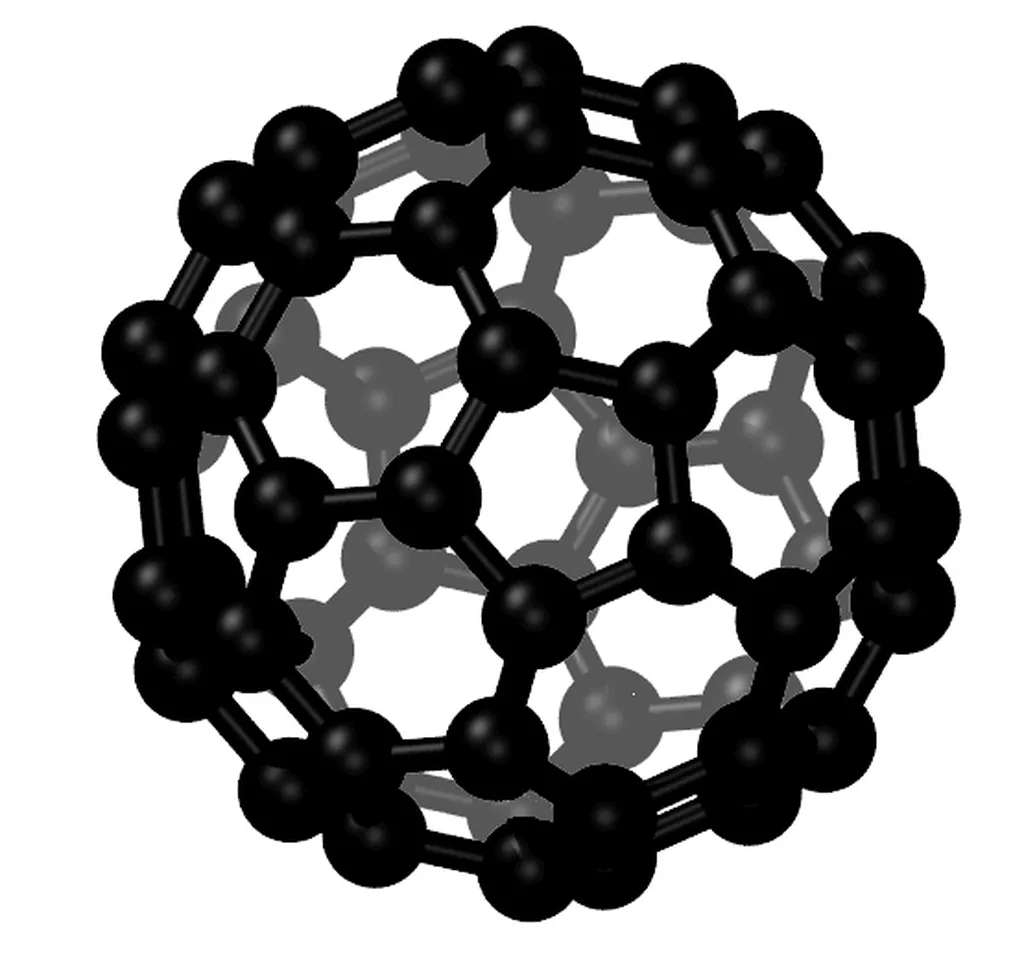
In the realm of energy materials, a recent study by Gennadiy Ivanovich Mironov from the Institute of Strength Physics and Materials Science in Tomsk, Russia, has shed new light on the electronic properties of fullerene C60. The research, published in the Journal of Chemical Physics, focuses on understanding the ionization energy and electron affinity of C60 within the framework of the Hubbard model, a simplified model used to describe the transition of electrons between different sites in a material.
The study employs the static fluctuation approximation to calculate these properties. Ionization energy is the energy required to remove an electron from a material, while electron affinity is the energy released when an electron is added to a material. These properties are crucial for understanding how fullerenes interact with other materials and their potential applications in energy storage and conversion devices.
Mironov first derived a graphical representation of the chemical potential equation, which describes the energy required to add or remove an electron. He then calculated the correlation function, which describes the movement of π-electrons (electrons in the outer shell of carbon atoms) from one site to the nearest site in the fullerene structure. Additionally, he calculated the thermodynamic average, which characterizes the probability of finding two π-electrons with opposite spin projections on a single site.
The theoretical values obtained for the ionization energy (7.57 eV) and electron affinity (2.67 eV) closely match experimental observations. This agreement suggests that fullerene C60 behaves as a single system of strongly correlated π-electrons when subjected to external perturbations, such as photoionization. This finding has significant implications for the energy industry, as it enhances our understanding of how fullerenes can be used in various applications, such as solar cells, batteries, and organic electronics. The strong correlation of π-electrons in fullerenes can potentially improve the efficiency of these devices by enhancing their electronic properties.
In practical terms, this research could lead to the development of more efficient energy storage and conversion technologies. For instance, fullerenes could be used to improve the performance of lithium-ion batteries by enhancing their capacity and stability. Moreover, their unique electronic properties could be harnessed to create more efficient solar cells and organic light-emitting diodes (OLEDs). The study’s findings provide a solid theoretical foundation for further exploration of fullerenes in these applications.
Source: Journal of Chemical Physics, Volume 155, Issue 12, 124703 (2021)
This article is based on research available at arXiv.