
In the realm of high-energy physics, researchers like Patrycja Potępa from the ATLAS collaboration at CERN are delving into the mysteries of particle production in heavy-ion collisions. Their work, recently published in the journal Nature Physics, focuses on top-quark pair production, a process that offers unique insights into nuclear matter and the quark-gluon plasma, a state of matter thought to have existed just after the Big Bang.
The ATLAS experiment at the Large Hadron Collider (LHC) has observed and measured top-quark pair production in both proton-lead (p+Pb) and lead-lead (Pb+Pb) collisions. In p+Pb collisions at a centre-of-mass energy of 8.16 TeV, top-quark pairs were detected in two distinct channels: lepton+jets and dilepton. The observations in these channels were statistically significant, exceeding 5 standard deviations, which is a strong indication that the results are not due to random chance. This measurement allowed researchers to calculate the nuclear modification factor, RpA, for the first time in this process. The nuclear modification factor helps scientists understand how partons, the constituents of protons and neutrons, are distributed within the nucleus.
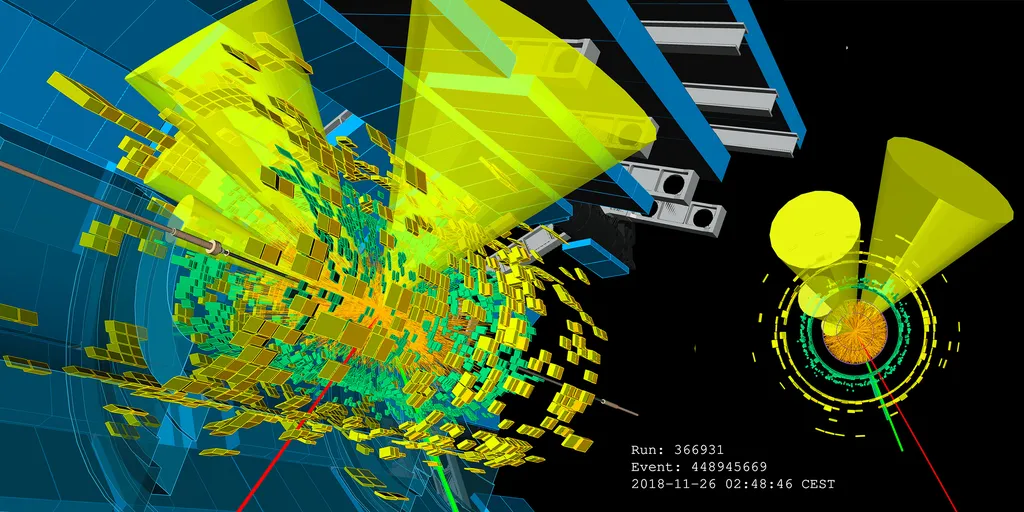
In Pb+Pb collisions at a centre-of-mass energy of 5.02 TeV, the ATLAS team studied top-quark pair production in the electron-muon (eμ) final state. Using datasets recorded in 2015 and 2018, with a combined integrated luminosity of 1.9 nb⁻¹, the measurement achieved a significance of 5.0 standard deviations. The results were then compared to theoretical predictions based on various nuclear parton distribution function (PDF) sets. Nuclear PDFs are essential for understanding the structure of atomic nuclei and the behavior of particles within them.
The practical applications of this research for the energy sector are not immediate, as this is fundamental research in particle physics. However, understanding the fundamental forces and particles that make up our universe can sometimes lead to unexpected technological advancements. For instance, the World Wide Web was invented at CERN to facilitate the sharing of information among scientists. Moreover, advancements in accelerator technology and particle detection can have applications in medical imaging, cancer treatment, and other areas. In the long term, a deeper understanding of nuclear matter and the quark-gluon plasma could potentially inform the development of new energy technologies, but this is purely speculative at this stage.
In conclusion, the ATLAS experiment’s observations of top-quark pair production in heavy-ion collisions provide valuable insights into nuclear matter and the quark-gluon plasma. While the direct applications to the energy sector may not be apparent, the pursuit of fundamental science often leads to unexpected technological advancements that can benefit society in numerous ways.
This article is based on research available at arXiv.