
In the realm of astrophysics and energy research, a team of scientists from the University of Science and Technology of China has delved into the complex world of black holes, specifically Kerr-Newman black holes, to understand how these cosmic entities influence the behavior of light and its polarization. Their work, published in the journal Physical Review D, offers insights that could have implications for our understanding of energy propagation in extreme environments.
The researchers, Xin Li, Guo Sen, Pei Wang, En-Wei Liang, Xiao-Xiong Zeng, and Kai Lin, have developed a sophisticated numerical framework to study the polarization radiation imaging of Kerr-Newman black holes. Traditional methods, like the Walker-Penrose method, have limitations due to their dependence on specific symmetric structures and Killing tensors. To overcome these constraints, the team constructed an ordinary differential equations (ODEs) numerical framework that integrates the photon orbit equation with the polarization parallel transport equation. This approach allows for the self-consistent evolution of photon trajectories and polarization states in any spacetime backgrounds, without relying on specific symmetries.
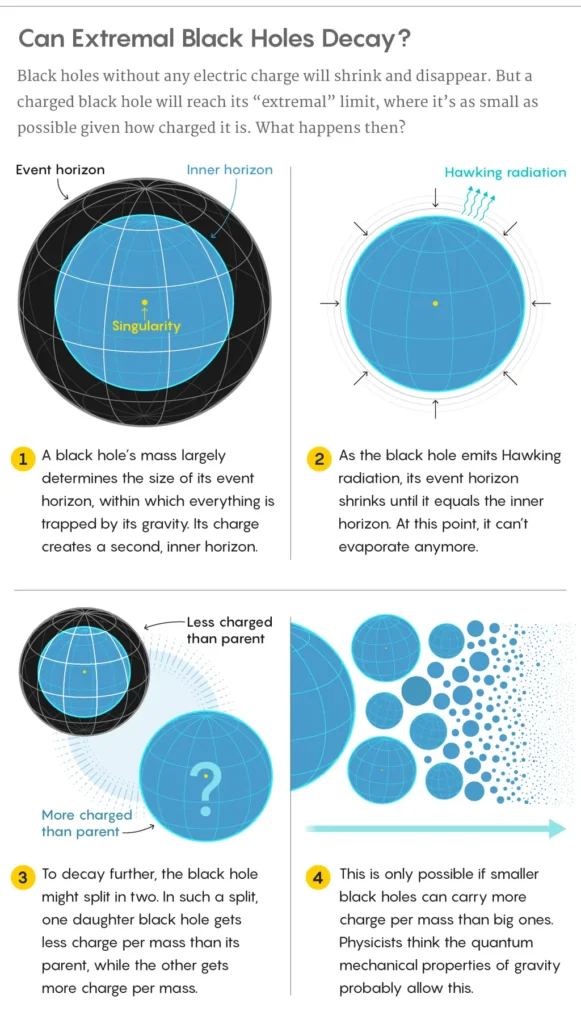
The study focuses on the impact of black hole charge on photon propagation and polarization characteristics. By analyzing the effects of black hole spin and charge on the polarization characteristics of radiation from both prograde and retrograde accretion disks, the researchers found that black hole charge can significantly alter photon trajectories and polarization patterns. Specifically, increasing the charge of a black hole compresses and distorts the Electric Vector Position Angle (EVPA) structure on photon-ring scales, inducing localized rotations and asymmetries. These modifications could serve as a potential diagnostic for detecting a nonzero black hole charge.
For the energy sector, understanding the behavior of light and its polarization in extreme environments like black holes can provide insights into the fundamental physics of energy propagation. This research could contribute to the development of advanced energy technologies that rely on the manipulation of light and other forms of electromagnetic radiation. Additionally, the numerical framework developed by the researchers could be adapted for use in other areas of energy research, where the behavior of particles and radiation in complex environments needs to be modeled accurately.
In summary, the work of Xin Li and his colleagues offers a deeper understanding of the interaction between black holes and electromagnetic radiation, with potential applications in the energy sector. Their innovative numerical framework and findings on the effects of black hole charge on photon trajectories and polarization patterns represent a significant advancement in the field of astrophysics and energy research.
This article is based on research available at arXiv.