
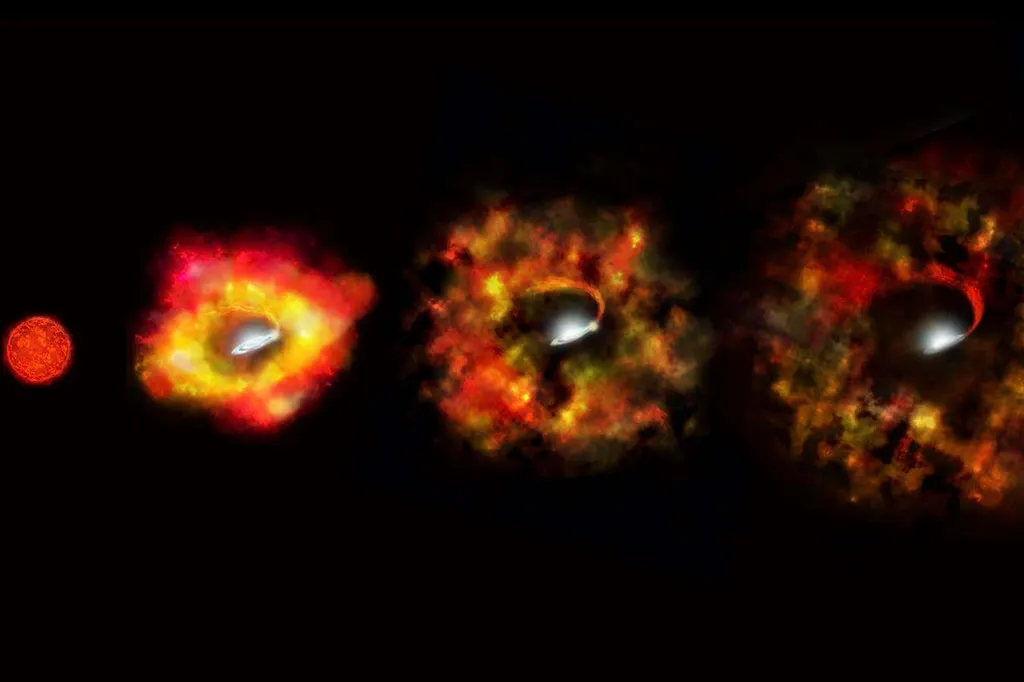
In the realm of astrophysics and energy research, Noam Soker, a researcher from the Technion – Israel Institute of Technology, has recently scrutinized a proposed scenario for the fading of a yellow supergiant event, M31-2014-DS1. His findings, published in the Monthly Notices of the Royal Astronomical Society, challenge the viability of the ‘failed-supernova’ scenario, offering insights that could indirectly influence our understanding of stellar energy processes and core-collapse supernovae mechanisms.
Soker’s study focuses on the ‘failed-supernova’ scenario, where a yellow supergiant’s core collapses into a black hole, ejecting only a small fraction of its outer envelope. The ejected material, driven by neutrino energy from the collapsing core, forms intermittent accretion disks around the black hole. These disks launch jets or winds that unbind most of the bound material. However, Soker argues that this scenario requires fine-tuned parameters to work, making it unlikely. Specifically, the scenario necessitates that less than 1% of the bound material be accreted by the black hole, and that the jets remain active for over a decade to prevent backflow, a requirement Soker deems improbable.
Moreover, Soker’s calculations suggest that the expected radiation from the interaction of the outflow with the outer gas is about an order of magnitude or more above the observed value, due to the rapid radiative cooling of the outflow interaction zone. This discrepancy further undermines the failed-supernova scenario. Instead, Soker advocates for an alternative scenario, the type II intermediate-luminosity optical transient, where fading is attributed to dust ejection in a violent binary interaction.
While this research may not have direct practical applications for the energy industry, it contributes to our broader understanding of stellar evolution and core-collapse supernovae, which are crucial for modeling stellar energy production and the lifecycle of stars. The study also highlights the importance of robust theoretical models in predicting and explaining astronomical phenomena, a principle that can be applied to various fields, including energy research.
This article is based on research available at arXiv.