
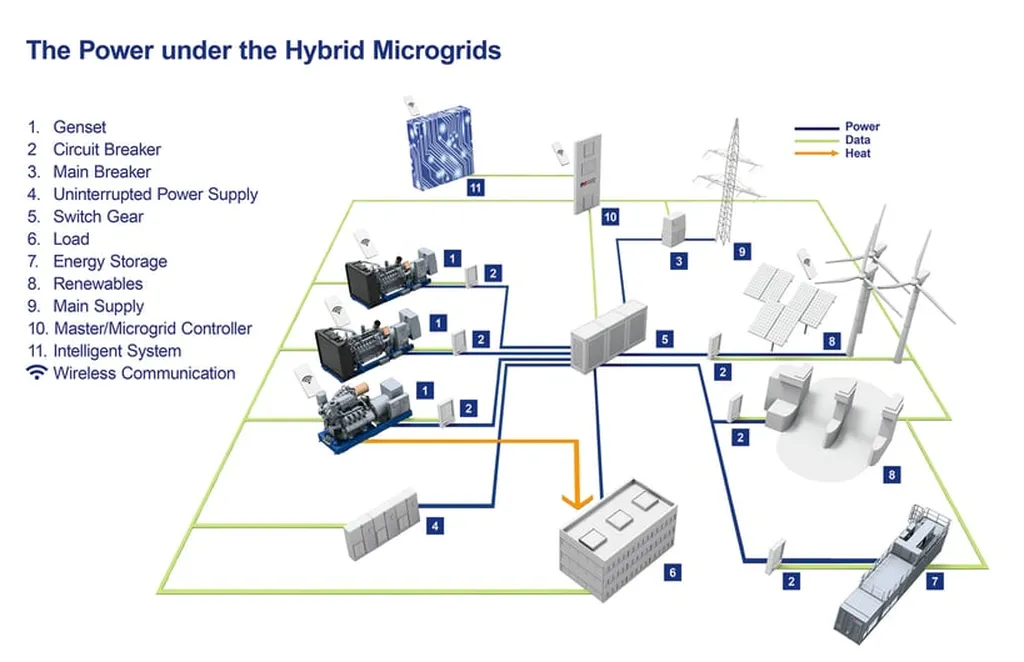
Researchers from the University of Texas at Austin, led by Lifu Ding, Chunhui Hou, Yutong Li, and Qinmin Yang, have developed a new control strategy for hybrid microgrids that aim to improve power sharing accuracy and operational resilience. Their work, published in the IEEE Transactions on Smart Grid, addresses the complex challenges of integrating Grid-Following (GFL) and Grid-Forming (GFM) inverters in microgrids.
Microgrids are localized power grids that can operate independently or in conjunction with the main power grid. They often incorporate a mix of power sources, including renewable energy, and can improve energy efficiency and reliability. However, managing these diverse power sources presents significant control challenges, particularly when integrating GFL and GFM inverters. GFL inverters follow the grid’s voltage and frequency, while GFM inverters actively form and control the grid’s voltage and frequency. This difference can lead to conflicts between long-term economic dispatch and real-time dynamic regulation, as well as physical limitations under cyber uncertainties.
The researchers propose a Resilient Hierarchical Power Control (RHPC) strategy to unify these conflicting requirements. The RHPC strategy introduces a standardized power increment mechanism that bridges the tertiary (long-term economic dispatch) and secondary (real-time dynamic regulation) layers. This ensures that real-time load fluctuations are compensated according to the optimal economic ratios derived from the tertiary layer.
To address the strict active power saturation constraints of GFL units, the RHPC strategy employs a dynamic activation scheme coupled with projection operators. This scheme actively isolates saturated nodes from the consensus loop to prevent integrator wind-up and preserve the stability of the GFM backbone. Additionally, the framework incorporates a multi-scale attention mechanism and LSTM-based predictors into the secondary control protocol. These enhancements make the system robust against unbounded False Data Injection (FDI) attacks and packet losses.
The researchers conducted rigorous theoretical analysis and simulations on a modified IEEE 33-bus system to validate their approach. Their results demonstrate that the RHPC strategy significantly improves power sharing accuracy and operational resilience in both grid-connected and islanded modes compared to conventional methods. The system achieves Uniformly Ultimately Bounded (UUB) convergence, ensuring stable and efficient operation.
This research has practical applications for the energy sector, particularly in enhancing the control and management of hybrid microgrids. By improving power sharing accuracy and operational resilience, the RHPC strategy can help optimize energy distribution, reduce costs, and enhance the reliability of microgrid systems. This is crucial for integrating renewable energy sources and ensuring stable power supply in both urban and remote areas.
This article is based on research available at arXiv.