
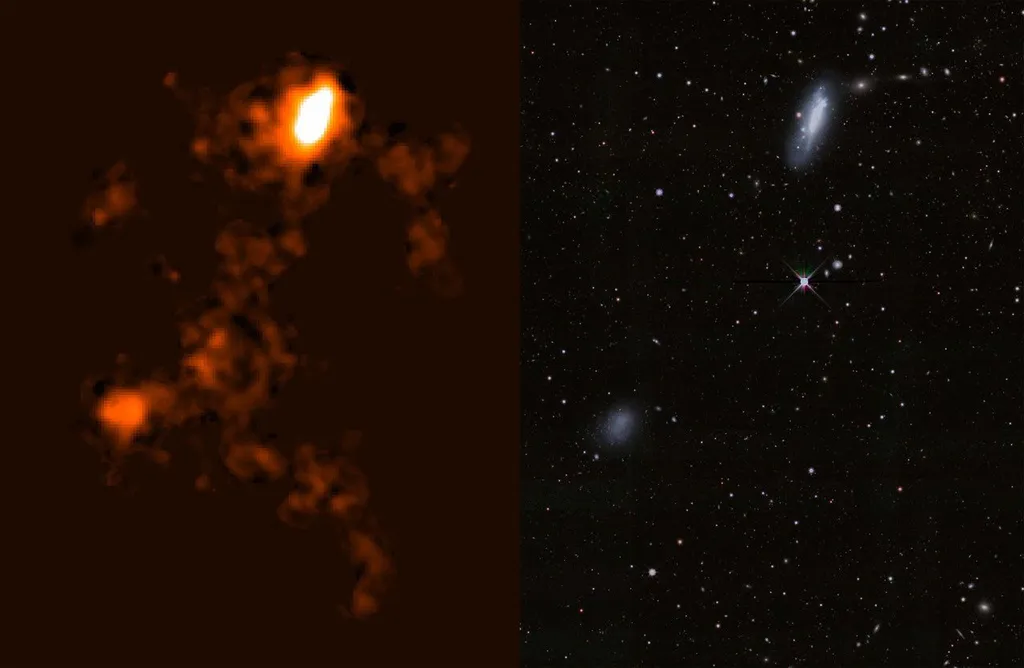
Researchers Jamie Incley and Laura Wolz from the University of Melbourne have published a study that explores the transition of neutral hydrogen (HI) gas from the end of the Epoch of Reionization (EoR) to the formation of large-scale cosmic structures. Their work, published in the journal Monthly Notices of the Royal Astronomical Society, uses advanced simulations to model the HI signal and predict its detectability using the upcoming Square Kilometre Array (SKA) radio telescope.
The Epoch of Reionization was a crucial period in the early universe when the first stars and galaxies ionized the surrounding neutral hydrogen gas. Understanding this transition is vital for cosmology and can provide insights into the formation and evolution of cosmic structures. Incley and Wolz’s study focuses on the redshifted 21-cm line, a specific wavelength of light emitted by neutral hydrogen, to trace this transition.
The researchers used a semi-numerical simulation called 21cmFAST to model the HI during the EoR and combined it with a post-processing model to simulate the late-time HI. This approach allowed them to estimate the amplitude of the HI temperature field and predict the observable power spectrum during the transition period. Their simulations reproduced expected power spectrum trends from existing observations and theoretical predictions, as well as current observational constraints on the amount of neutral hydrogen in the universe (Ω_HI).
One of the key findings of the study is a predicted drop in power of four orders of magnitude between redshifts 4 and 7. This drop is attributed to the transition from a universe filled with neutral hydrogen to one dominated by ionized gas and the formation of large-scale structures. Additionally, the simulations suggest a flattening of the power spectrum due to lingering neutral islands masking the late-time HI signal for redshifts between 5 and 6.5.
The study also assessed the detectability of the HI power spectrum using the SKA-Low deep survey parameters. The results indicate that the HI power spectrum can be detected at scales up to 1 h Mpc^-1 for redshifts between 3 and 7, even when using the horizon limit to mitigate foregrounds. This detectability suggests a sufficient signal-to-noise ratio (SNR) of the HI power spectrum tracing the underlying halos for redshifts less than 5, which can be used for late-time cosmology.
Practical applications for the energy sector from this research are indirect but significant. Understanding the distribution and evolution of neutral hydrogen in the universe can provide insights into the fundamental processes driving cosmic structure formation. This knowledge can inform models of galaxy evolution, which in turn can help refine our understanding of the universe’s large-scale structure. Such insights are crucial for developing accurate models of the universe’s expansion and the distribution of dark matter, which are essential for understanding the cosmic microwave background and the large-scale structure of the universe. These findings can also help in the development of more accurate cosmological models, which are vital for a wide range of applications, including energy production, climate modeling, and space exploration.
In conclusion, Incley and Wolz’s study highlights the potential of deep SKA-Low observations for redshifts between 3 and 7 to constrain reionization parameters and cosmological models. Their work provides a robust framework for future observations and simulations, paving the way for a deeper understanding of the early universe and the processes that shaped it.
This article is based on research available at arXiv.