
Researchers from the University of Barcelona, Pere Masjuan and Hubert Spiesberger, along with Balma Duch, have recently published a study in the Journal of High Energy Physics that delves into the intricacies of particle physics, with potential implications for our understanding of fundamental forces and interactions. Their work focuses on the calculation of a specific quantum correction, known as the γZ box-graph, to electron-quark scattering at low energy and low momentum transfer.
In their research, the team considered both electron and quark masses to be non-zero, providing a more realistic scenario for their calculations. From their results, they derived coupling constants for a low-energy effective Lagrangian that includes parity-violating 4-fermion interaction terms. These terms describe interactions between particles that do not respect the symmetry of parity, a concept in physics that refers to the mirror image of an object or event.
The researchers also explored the zero-mass limits of their calculations, demonstrating that a non-zero electron mass is sufficient to obtain finite, well-defined couplings. These couplings are insensitive to a hadronic mass cutoff, a threshold used in calculations to separate the behavior of different types of particles. This finding suggests that the electron mass plays a crucial role in the stability and predictability of these interactions.
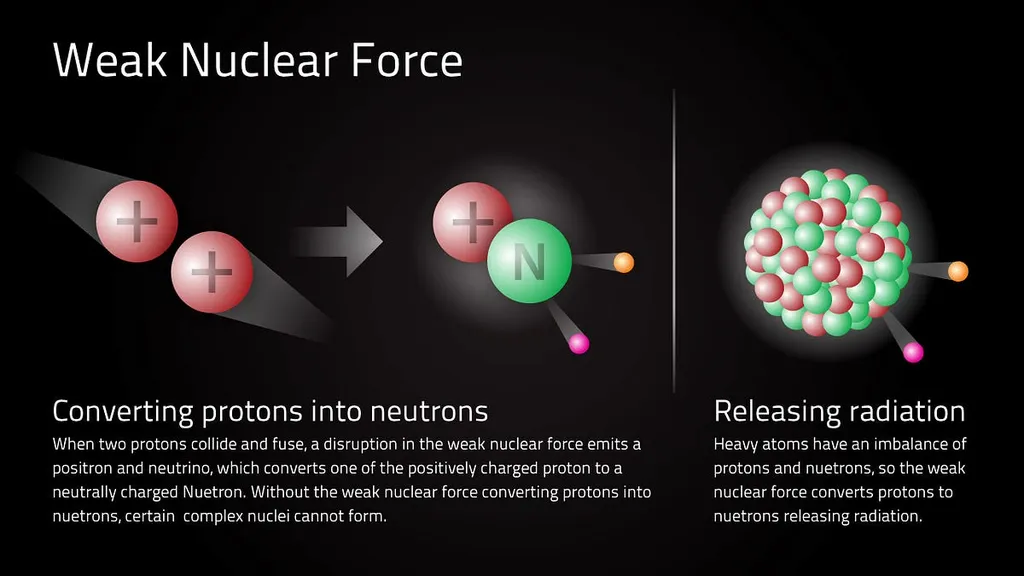
One of the most significant aspects of this research is its potential impact on the determination of the weak charge of the proton. The weak charge is a fundamental property of protons that describes their interaction with the weak force, one of the four fundamental forces in physics. By studying polarized electron-proton scattering, scientists can gain insights into the weak charge of the proton, and the results of this study could refine those determinations.
In the context of the energy industry, understanding these fundamental interactions can contribute to the development of advanced technologies, such as nuclear energy and particle accelerators. A deeper comprehension of the weak force and its interactions with matter can lead to innovations in energy production, storage, and transmission. Additionally, the methods and insights gained from this research can be applied to other areas of physics, furthering our understanding of the universe and its underlying principles.
Source: Journal of High Energy Physics
This article is based on research available at arXiv.