
In the realm of astrophysics and energy research, a trio of scientists from the Instituto Argentino de Radioastronomía—Lucas M. Pasquevich, Gustavo E. Romero, and Matías M. Reynoso—have delved into the enigmatic world of ultraluminous X-ray sources (ULXs) and their potential to produce high-energy neutrinos. Their findings, published in the journal Astronomy & Astrophysics, offer intriguing insights that could have implications for neutrino astronomy and our understanding of extreme astrophysical environments.
Ultraluminous X-ray sources are celestial objects that emit X-rays at levels that seem to defy the Eddington limit, the theoretical maximum luminosity for a star of a given mass. These sources are generally believed to be X-ray binaries, where a compact object like a black hole or neutron star accretes matter from a companion star at super-Eddington rates. In this scenario, the accretion disk becomes geometrically and optically thick, and powerful radiation-driven winds form funnel-shaped structures. While the X-ray emission can be intense within this funnel, a misalignment with our line of sight can render the ULX electromagnetically obscured.
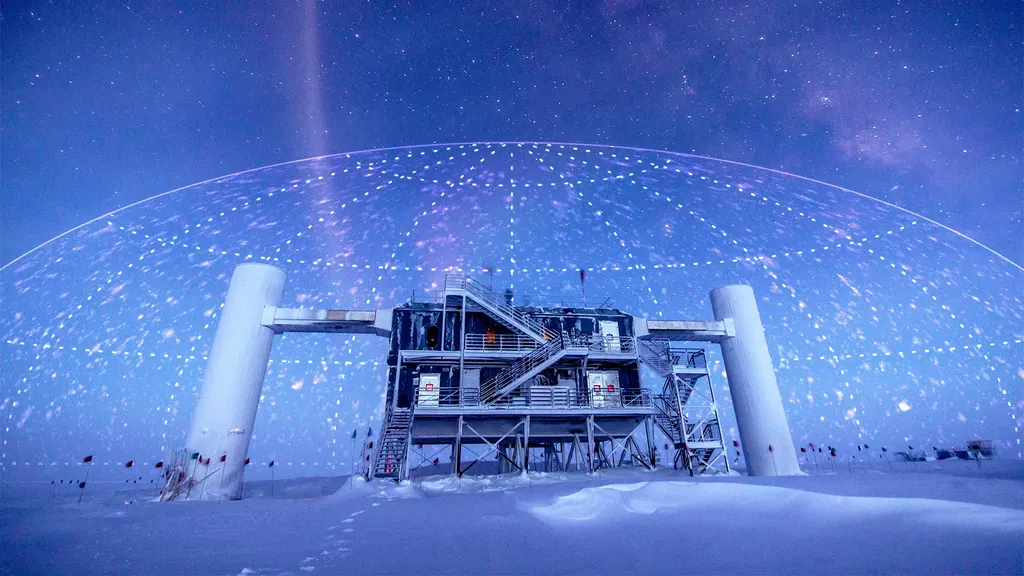
The researchers explored the potential for these obscured ULXs to produce high-energy neutrinos. Neutrinos are elementary particles that interact very weakly with matter, allowing them to travel vast cosmic distances without being absorbed or deflected. The team modeled proton acceleration via magnetic reconnection in the region above the super-accreting black hole. In this extreme environment, protons can interact with the dense wind and radiation fields, producing pions and muons that subsequently decay into neutrinos. These neutrinos can escape the dense environment and potentially be detected by Earth-based instruments like KM3NeT and IceCube.
The study’s results suggest that misaligned, electromagnetically obscured Galactic ULXs could produce a detectable neutrino flux within several years of observation. This finding could open up new avenues for neutrino astronomy, a field that uses neutrinos to probe the universe’s most violent and energetic processes. For the energy sector, understanding these extreme astrophysical environments can provide insights into fundamental physics, such as particle acceleration mechanisms and the behavior of matter under extreme conditions. While direct practical applications may be distant, the research underscores the importance of fundamental science in driving technological innovation and expanding our knowledge of the universe.
The research was published in the journal Astronomy & Astrophysics, a respected publication in the field of astrophysics and space science.
This article is based on research available at arXiv.