
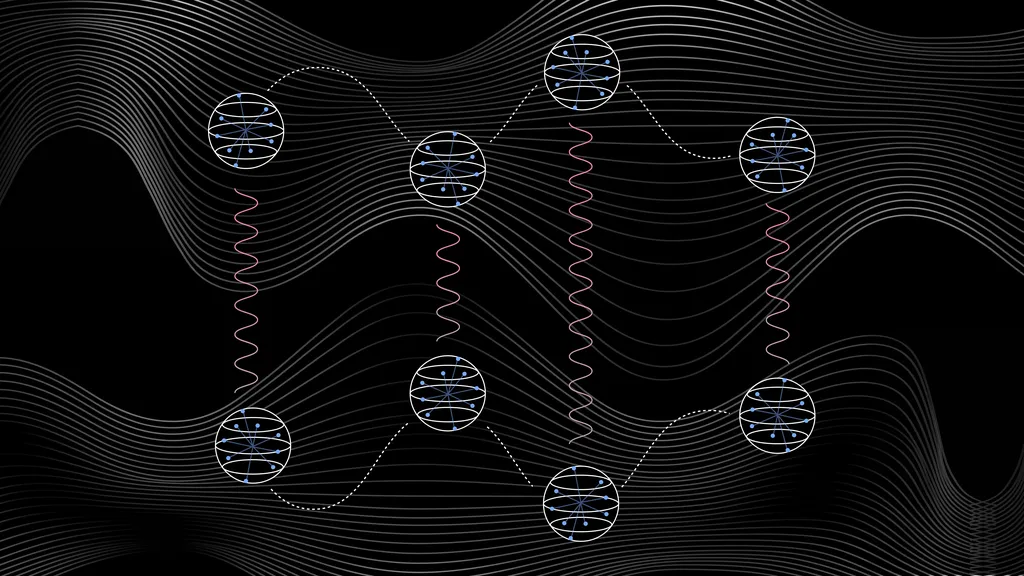
In the realm of quantum computing and high-energy physics, a team of researchers led by Tomoya Hayata, Yoshimasa Hidaka, and Yuta Kikuchi from the University of Tokyo has made significant strides in quantum simulation of complex physical systems. Their work, published in the prestigious journal Physical Review Letters, focuses on the thermalization dynamics of a quantum many-body system using a trapped-ion quantum computer.
The researchers have successfully demonstrated a quantum simulation of thermalization dynamics in a (2+1)-dimensional q-deformed SU(2) Yang-Mills theory. This theory is a simplified yet nontrivial model described by Fibonacci anyons, which preserves the essential nonabelian fusion structure of the gauge fields. The simulation was conducted using quantum circuits that explicitly implement F-moves, with the circuits executing up to 47 sequential F-moves.
One of the key challenges in this research was identifying and mitigating error sources. The team found that idling errors were the dominant error source in their simulations. To address this issue, they employed dynamical decoupling combined with a parallelized implementation of F-moves, effectively mitigating the errors and improving the accuracy of their simulations.
The practical applications of this research for the energy sector are not immediately apparent, as the work is primarily focused on fundamental physics and quantum computing. However, the development of quantum computing and simulation capabilities has the potential to revolutionize various industries, including energy. Quantum computers could be used to optimize complex systems, model molecular and chemical processes, and improve materials science, all of which could have significant implications for energy production, storage, and efficiency.
In summary, the research conducted by Hayata, Hidaka, and Kikuchi represents a significant advancement in the field of quantum simulation and high-energy physics. Their work demonstrates the potential of trapped-ion quantum computers to simulate complex quantum many-body systems and provides valuable insights into the thermalization dynamics of nonabelian gauge theories. While the direct applications to the energy sector may not be immediate, the broader implications of this research could have far-reaching impacts on various industries, including energy.
This article is based on research available at arXiv.