
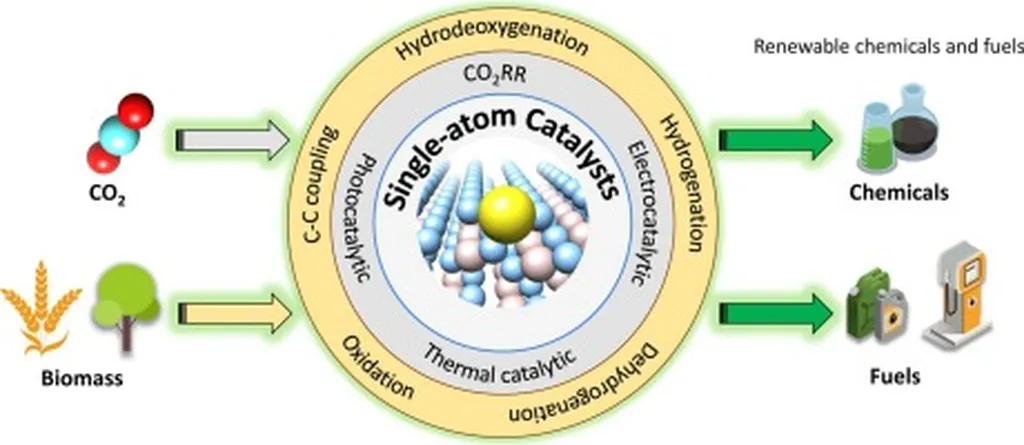
In a significant advancement for catalyst technology, a team of researchers led by Yue Li and Yang Xu from the University of Science and Technology of China has developed a novel method for creating single-atom catalysts (SACs) that could revolutionize energy conversion processes. Their work, published in the journal Nature Synthesis, introduces a scalable and precise approach to synthesizing SACs, which are highly efficient catalysts that maximize the use of each atom.
The researchers employed a non-equilibrium strategy using ion implantation, a technique typically used in semiconductor manufacturing, to create SACs. This method involves bombarding a support material with high-energy ions, which then embed themselves into the support’s surface. The team utilized an industrial-grade ion source to achieve wafer-scale implantation with high beam currents, enabling high-throughput fabrication of SACs. The unique combination of energy and mass effects during this process stabilizes individual metal atoms on the support material, preventing them from clustering together, which would reduce their catalytic efficiency.
The researchers demonstrated the versatility of their approach by creating a library of 36 different SACs. One of these, a platinum on molybdenum disulfide (Pt/MoS2) catalyst, exhibited exceptional performance in hydrogen evolution reactions, a key process in water splitting for hydrogen production. The Pt/MoS2 catalyst achieved an overpotential of only 26 mV at a current density of 10 mA cm-2, indicating its high efficiency. Moreover, it displayed outstanding long-term stability, outperforming commercial platinum on carbon (Pt/C) catalysts.
This research highlights the potential of ion implantation as a versatile platform for designing and manufacturing SACs. The scalability and precision of this method could facilitate the widespread adoption of SACs in various energy conversion applications, such as fuel cells, electrolyzers, and other catalytic processes. By enabling more efficient and stable catalysts, this technology could contribute to the development of cleaner and more sustainable energy systems.
The research was published in Nature Synthesis, a prominent journal in the field of chemical synthesis and catalysis. This work not only advances the fundamental understanding of SACs but also provides practical solutions for their scalable production, bridging the gap between laboratory research and industrial applications.
This article is based on research available at arXiv.