
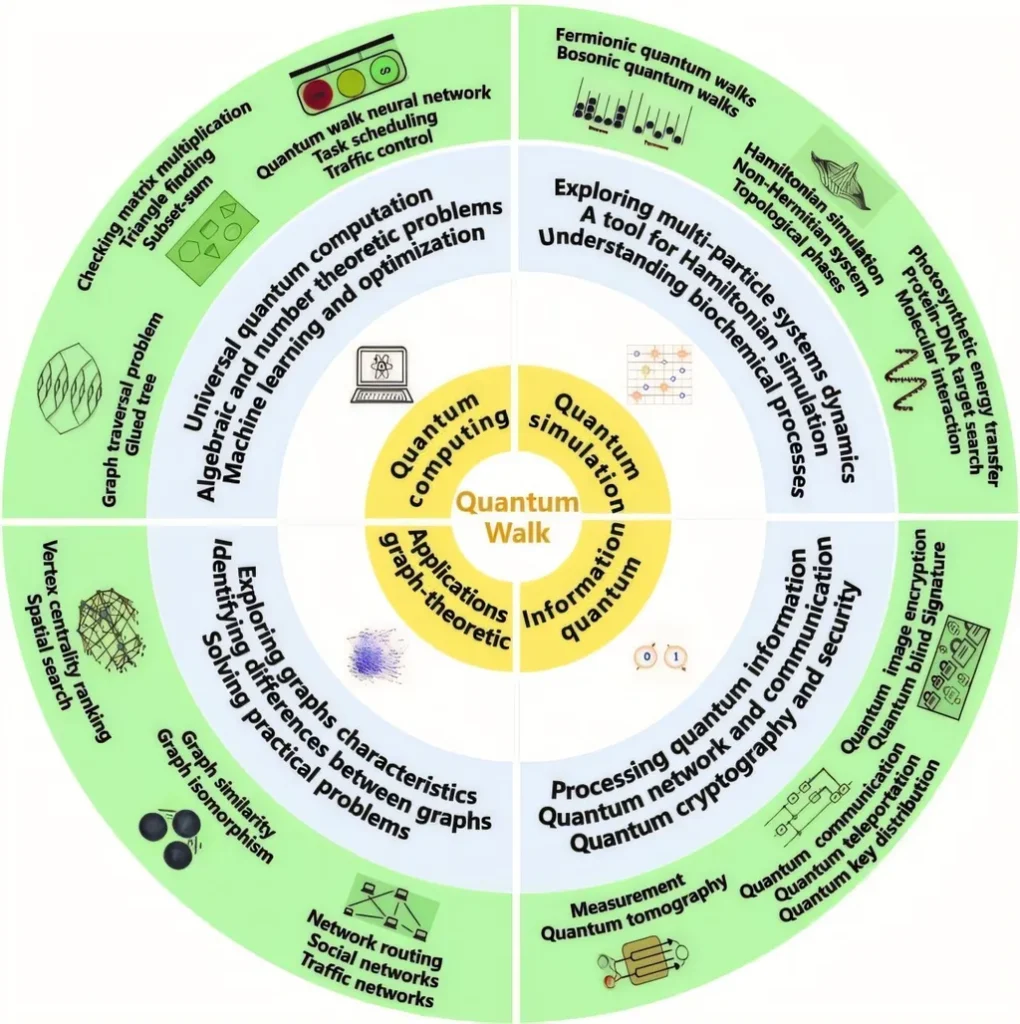
Researchers from Quix Quantum, a company specializing in photonic quantum technologies, have recently delved into the realm of quantum walks and their applications in quantum information processing. Quantum walks, a fundamental aspect of quantum dynamics, offer a robust framework for simulating quantum transport, designing search algorithms, and achieving universal quantum computation. The team, led by E. Stefanutti and including J. Phillips, J. Buetow, A. Guidara, M. Nuvoli, A. Chiuri, and L. Sansoni, has focused their efforts on photonic integrated circuits, a versatile platform for exploring various phenomena related to quantum walk-based protocols.
Quantum walks (QWs) have been implemented using several physical platforms, such as trapped atoms, ions, and nuclear magnetic resonance systems. However, photonic quantum systems, particularly those using integrated circuits, have shown great promise. These systems allow researchers to explore the evolution of QWs in the presence of different kinds of noise and other environmental factors. Despite this progress, few studies have investigated the introduction of absorbing centers and their effects on the coherence of quantum walk dynamics.
In their recent work, the Quix Quantum team presented and discussed results related to absorbing boundaries in quantum walks. They conducted theoretical simulations and experiments using universal photonic quantum processors. The study, published in the journal Physical Review A, provides valuable insights into how absorbing boundaries influence the coherence and behavior of quantum walks.
The practical applications of this research for the energy sector are still in the early stages, but the potential is significant. Quantum walks can be used to model and simulate complex systems, which could be beneficial for optimizing energy distribution networks, improving energy storage systems, and enhancing the efficiency of renewable energy technologies. Additionally, the development of quantum algorithms based on quantum walks could lead to more efficient computational tools for solving energy-related problems.
The Quix Quantum team’s work on absorbing boundaries in quantum walks represents a step forward in understanding and harnessing the power of quantum dynamics for practical applications. As research in this field continues to advance, we can expect to see more innovative solutions emerging from the intersection of quantum information processing and the energy sector.
This article is based on research available at arXiv.