
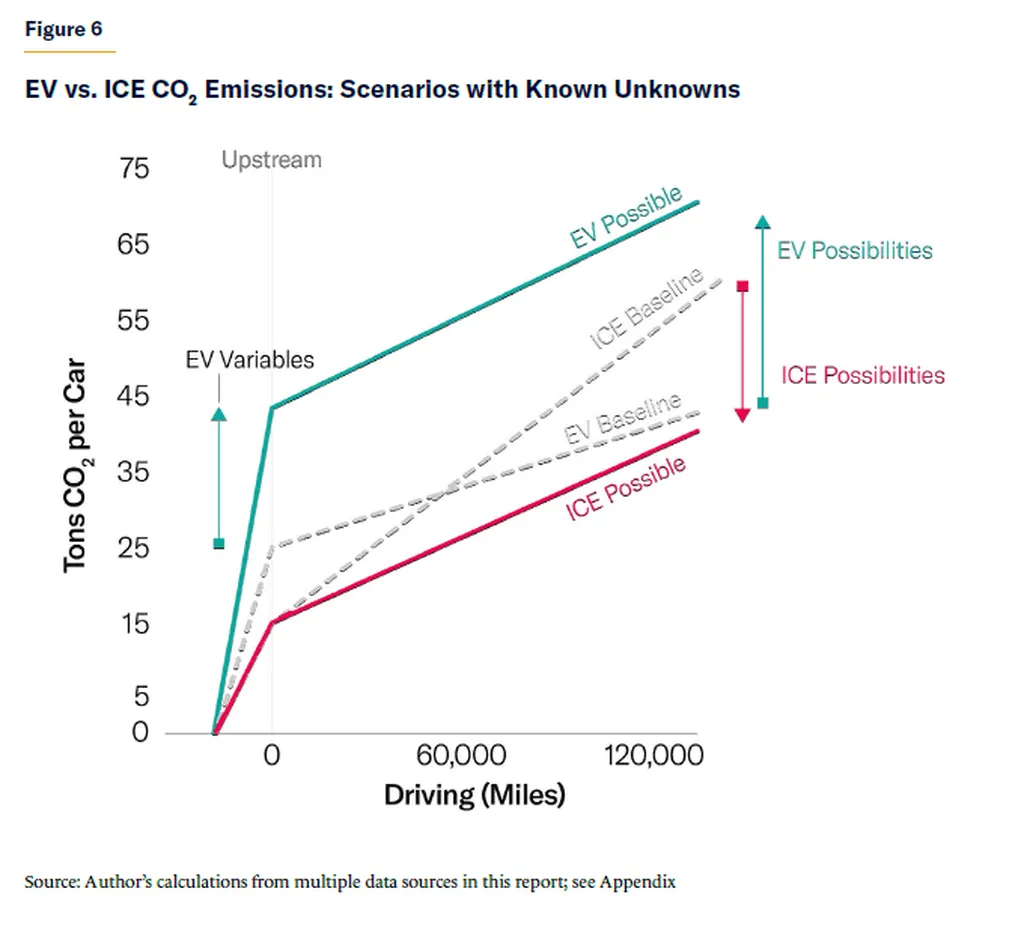
In the quest to decarbonize road transport, researchers from the Federal University of Rio de Janeiro have developed a novel approach to compare CO2 emissions between different vehicle technologies. Rodrigo Pereira David, Luciano Araujo Dourado Filho, Daniel Marques da Silva, and João Alfredo Cal-Braz have proposed a machine learning-based framework that enables fair and reproducible evaluation of powertrain technologies under real-world operating conditions. Their research was published in the journal Transportation Research Part D: Transport and Environment.
The team’s approach focuses on comparing internal combustion engine vehicles (ICEVs) and electric vehicles (EVs) under identical, real-world driving conditions. By using recurrent neural network models, they can isolate technology-specific effects and hold the observed speed profile and environmental context fixed. This allows for direct comparison of powertrain performance.
The researchers train separate models for each vehicle type to learn the mapping from contextual driving variables—such as speed, acceleration, and temperature—to internal actuation variables like torque and throttle, as well as instantaneous CO2-equivalent emission rates. This structure enables the construction of counterfactual scenarios, answering the question: What emissions would an EV have generated if it had followed the same driving profile as an ICEV?
By aligning both vehicle types on a unified instantaneous emissions metric, the framework offers a scalable foundation for credible, data-driven assessments of vehicle carbon performance. This approach is particularly valuable for the energy sector as it provides a consistent and transparent method for comparing the environmental impact of different vehicle technologies.
The practical applications of this research are significant. For instance, policymakers and automakers can use this framework to make informed decisions about vehicle design and regulation. Additionally, energy providers can better understand the environmental benefits of promoting electric vehicle adoption. The framework’s ability to handle real-world driving conditions makes it a powerful tool for assessing the true environmental impact of different powertrain technologies.
In summary, the researchers from the Federal University of Rio de Janeiro have developed a machine learning-based approach that enables fair and reproducible comparisons of CO2 emissions between ICEVs and EVs. This framework provides a valuable tool for the energy sector, offering a consistent and transparent method for evaluating the environmental impact of different vehicle technologies under real-world operating conditions.
This article is based on research available at arXiv.