
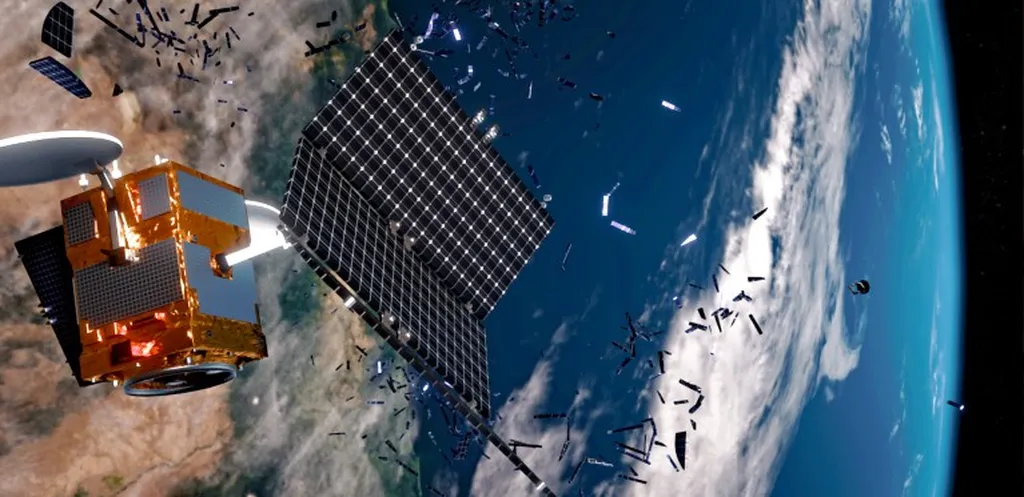
In the realm of space sustainability, a team of researchers from the Indian Institute of Science, including Om Mishra, Jayesh Patil, Sathwik Narkedimilli, G Srikantha Sharma, Ananda S, and Manjunath K Vanahalli, has introduced a novel approach to tackle the growing problem of orbital debris. Their work, published in the journal Acta Astronautica, presents a solar-electric autonomous module designed for multi-debris remediation, offering a promising solution to the challenges posed by traditional fuel-dependent methods.
The researchers have developed a unique remediation architecture that combines a mechanical clamping system for secure capture of debris with a high-efficiency, solar-powered NASA Evolutionary Xenon Thruster (NEXT). This system is further enhanced by autonomous navigation protocols, which enable precise and efficient debris removal. The team’s high-fidelity simulations have demonstrated the architecture’s capabilities, showcasing a successful retrograde deorbit from 800 km to 100 km. This process involves maneuvering the debris to a lower orbit where it will eventually burn up upon re-entry into the Earth’s atmosphere.
The simulations also revealed impressive navigation accuracy, with a position Root Mean Square Error (RMSE) of less than 10 meters using radar-based Extended Kalman Filter (EKF) navigation. Additionally, the system achieved a 93% data delivery efficiency within 1 second using Delay/Disruption Tolerant Network (DTN) protocols. These results highlight the potential of the solar-electric autonomous module to significantly advance orbital management by establishing a benchmark for renewable solar propulsion. By minimizing reliance on conventional fuels, this approach extends mission longevity and enhances the feasibility of multi-target removal.
The practical applications of this research for the energy sector are manifold. As the space industry continues to grow, so does the need for sustainable and efficient solutions to manage orbital debris. The solar-electric autonomous module offers a promising alternative to traditional methods, reducing the environmental impact and operational costs associated with debris removal. Furthermore, the successful integration of solar-powered propulsion systems demonstrates the potential for renewable energy technologies to play a crucial role in the future of space exploration and satellite operations. By embracing these innovations, the energy sector can contribute to the long-term sustainability of space operations and pave the way for a more efficient and environmentally friendly approach to managing orbital debris.
This article is based on research available at arXiv.