
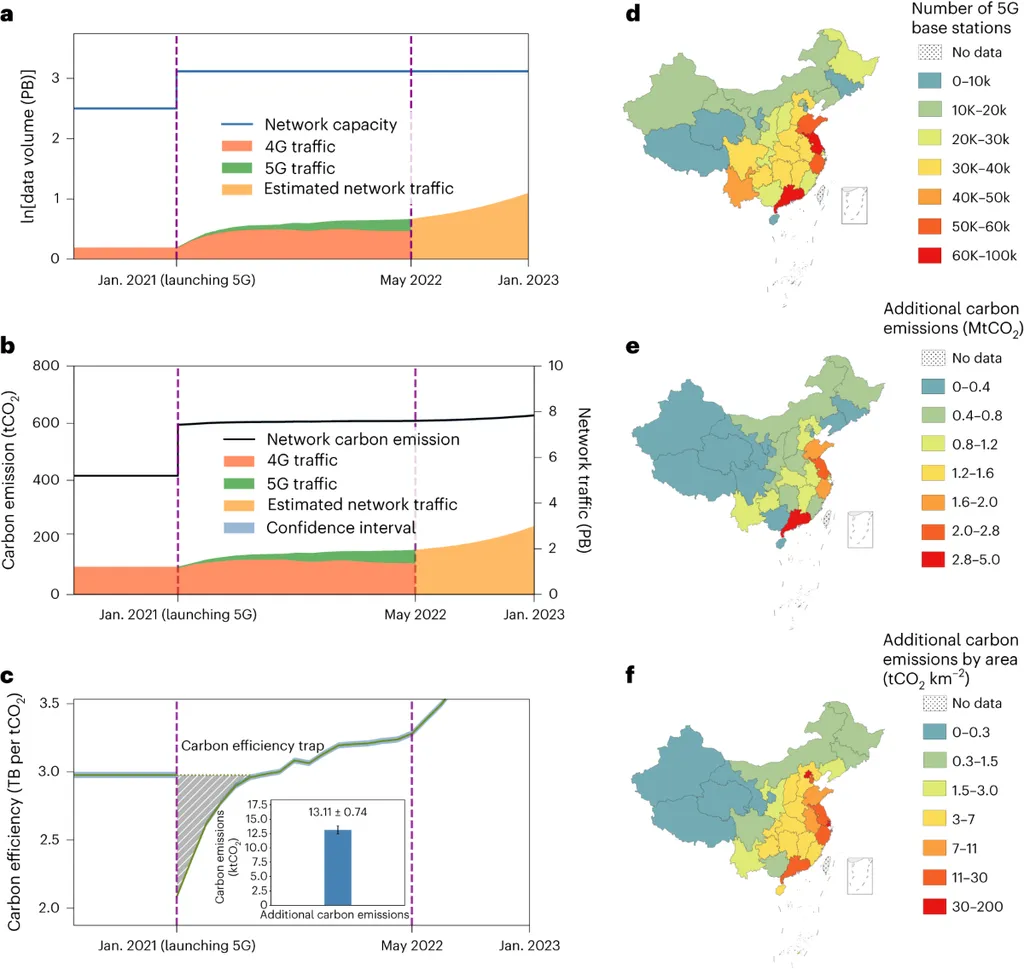
In the quest for a greener future, researchers from the University of Nottingham, Universitat Politècnica de València, and the University of Electronic Science and Technology of China have been exploring ways to optimize the use of renewable energy in cellular networks. Their recent study, published in the IEEE Internet of Things Journal, delves into the complex interplay between carbon emissions and network performance, offering practical solutions for the energy sector.
The team, led by Yuxi Zhao, investigated the challenges posed by the intermittent nature of renewable energy and the uneven distribution of network loads across base stations. These factors often lead to low utilization rates of renewable energy in cellular networks. To tackle this, the researchers modeled the renewable energy state of base station batteries and the number of occupied channels as a quasi-birth-death process. This approach allowed them to construct models for various performance metrics, including the probability of channel blocking, average successful transmission probability for users, downlink throughput, carbon emissions, and carbon efficiency.
The study’s key contribution is the proposal of an energy-based cell association scheme. This scheme aims to optimize the carbon efficiency of cellular networks by intelligently associating users with base stations based on their energy status. The results of the study are promising: compared to the traditional closest cell association scheme, the energy-based scheme can reduce network carbon emissions by 13.0% and improve carbon efficiency by 11.3%.
For the energy sector, these findings offer practical applications. By adopting energy-based cell association schemes, telecommunication companies can significantly reduce their carbon footprint while maintaining, or even improving, network performance. This not only contributes to global carbon reduction efforts but also aligns with the increasing demand for sustainable and eco-friendly technologies. The study serves as a stepping stone towards a more efficient and sustainable integration of renewable energy into the supply chain of cellular networks.
The research was published in the IEEE Internet of Things Journal, a prominent publication in the field of IoT and related technologies. The study’s findings are expected to have a significant impact on the energy sector, particularly in the realm of telecommunications and network infrastructure.
This article is based on research available at arXiv.