
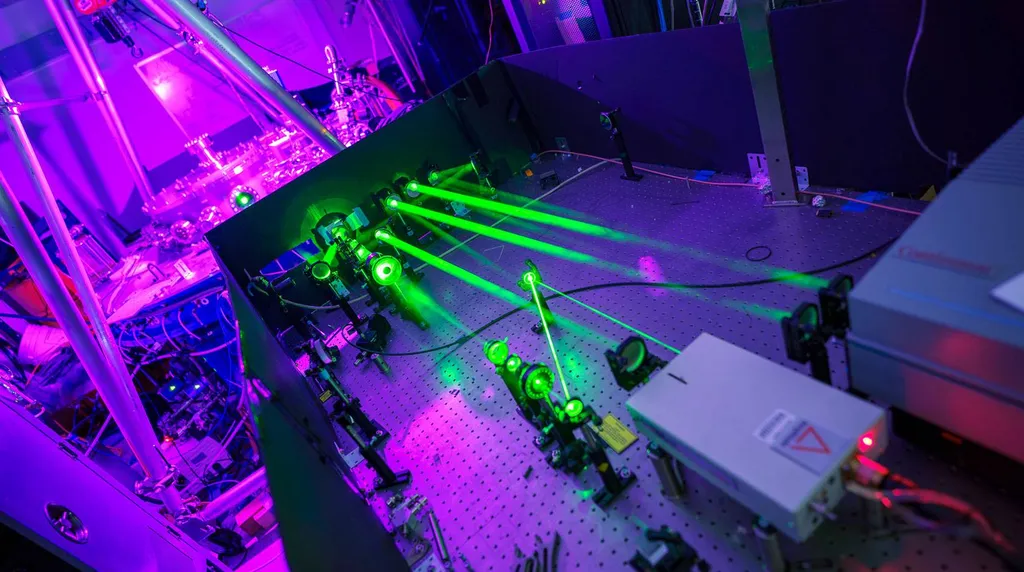
Researchers from the University of Warwick, led by S. M. Graham and colleagues, have been exploring the potential of diamond-based magnetometers for use in tokamak fusion reactors. Their work, published in the journal Review of Scientific Instruments, focuses on the use of nitrogen vacancy centers (NVC) in diamonds for high-field magnetometry, a critical need for efficient control and monitoring of fusion reactions.
Tokamaks are devices used in nuclear fusion research to confine hot plasma with magnetic fields. Effective control of these reactions requires precise magnetic field measurements, and traditional magnetometers can struggle in the intense radiation and high magnetic fields found in tokamaks. Diamonds, with their nitrogen vacancy centers, offer a promising alternative due to their radiation hardness and ability to function in high magnetic fields.
The researchers demonstrated the use of fiber-coupled ensemble NVC optically detected magnetic resonance (ODMR) for magnetometry measurements at magnetic fields up to 1.2 tesla. This is a significant achievement, as it shows that diamond magnetometers can operate in the high magnetic fields typical of tokamaks. The team achieved sensitivities ranging from approximately 240 to 600 nanoTesla per square root Hertz, and 110 nanoTesla per square root Hertz in a frequency range of 10 to 150 Hertz, depending on the field alignment.
The practical applications of this research for the energy sector are substantial. As fusion energy moves closer to becoming a viable power source, the need for robust and accurate diagnostic tools becomes increasingly important. Diamond magnetometers could provide the necessary measurements for efficient control of fusion reactions, helping to bring this clean and virtually limitless energy source online. Moreover, the radiation hardness of diamond magnetometers could also make them useful in other harsh environments within the energy sector, such as in nuclear power plants or in geothermal energy exploration.
In summary, the research conducted by Graham and colleagues represents a significant step forward in the development of diamond-based magnetometers for use in tokamak fusion reactors. Their work demonstrates the potential of these devices to operate in the high magnetic fields and intense radiation environments typical of fusion reactions, paving the way for more efficient and accurate control of this promising energy source.
This article is based on research available at arXiv.