
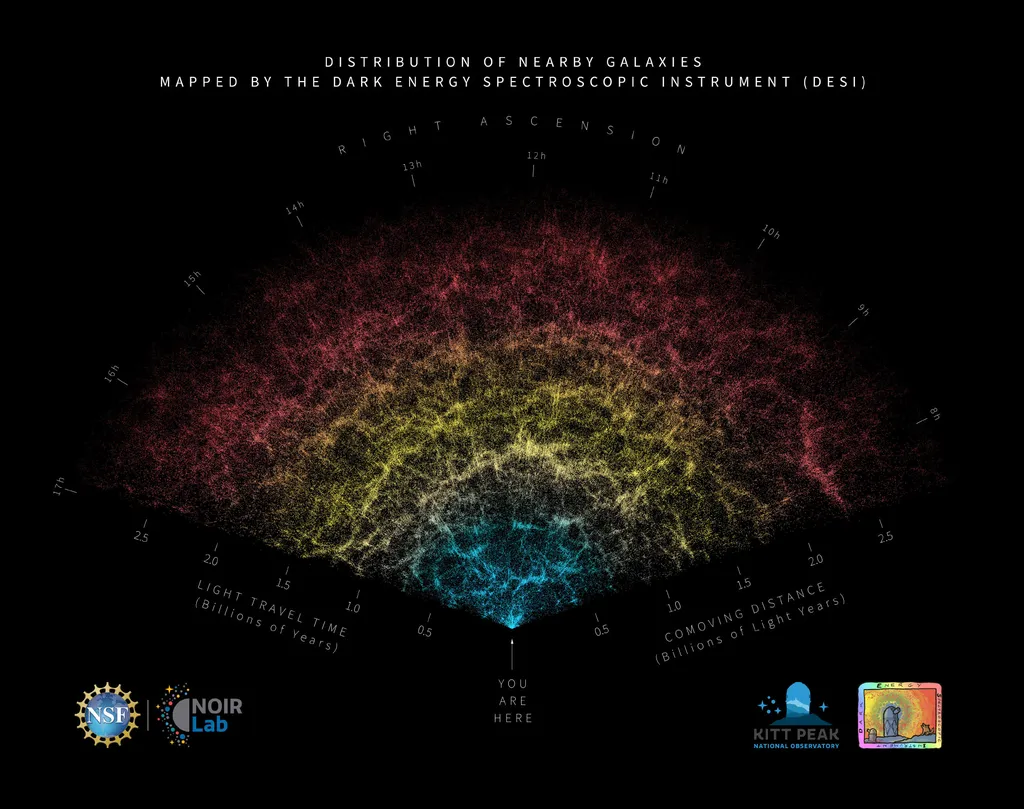
Researchers from the Dark Energy Spectroscopic Instrument (DESI) collaboration, led by Xander J. Hall and Antonella Palmese, have published a study detailing the first systematic spectroscopic observations of extragalactic transients. The team, comprising scientists from various institutions, has leveraged DESI’s capabilities to discover and classify these transient events, which are sudden changes in the brightness of astronomical objects.
The DESI Transients Survey program, as outlined in the study published on arXiv, utilizes DESI’s 5,000 fibers and an 8 square degree field of view to observe and classify transients. The researchers presented classifications from archival DESI data in Data Releases 1 and 2, as well as observations from the first six months of the DESI spare fiber program dedicated to transients. This program is coordinated with a dedicated DECam time-domain survey, serving as a precursor to what can be achieved in conjunction with the Rubin Observatory Legacy Survey of Space and Time (LSST).
The study classified over 250 transients, the majority of which were previously unclassified. These transients include thermonuclear and core-collapse supernovae and tidal disruption events (TDEs). Notably, the researchers observed a TDE before its discovery in imaging, demonstrating DESI’s ability to classify a population of faint transients down to a magnitude of r~22.5 during main survey operations. The impact on DESI’s main observations was found to be negligible.
The practical applications of this research for the energy sector are indirect but significant. Understanding the nature and behavior of extragalactic transients contributes to our broader knowledge of the universe, which can inform the development of advanced technologies and materials used in energy production and storage. Additionally, the methods and technologies developed for astronomical observations can often be adapted for use in other scientific and industrial applications, including energy research.
This article is based on research available at arXiv.