
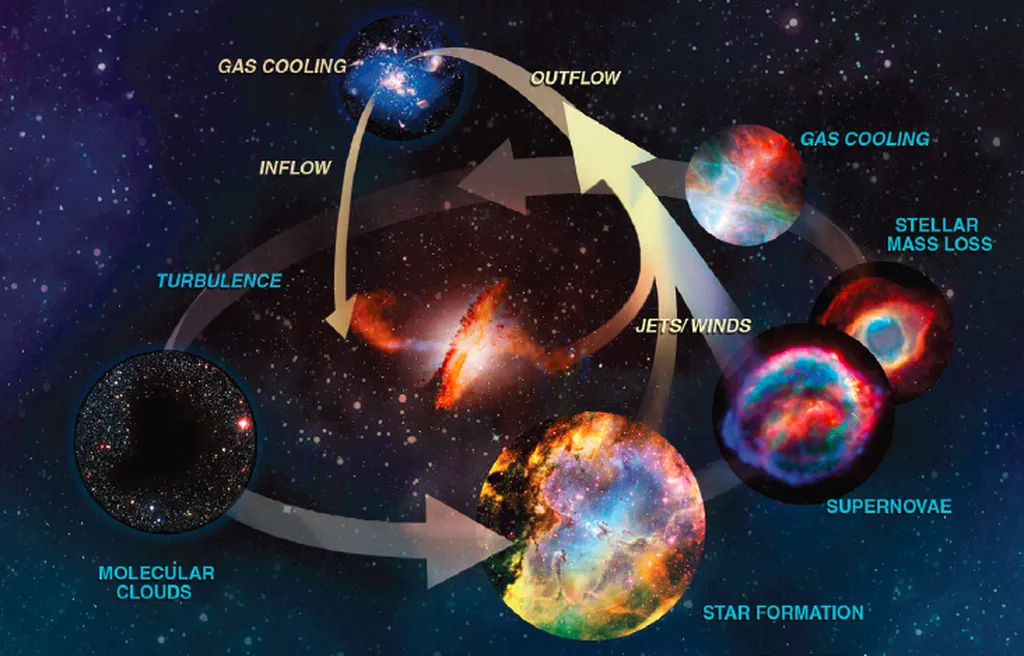
In the realm of energy journalism, a recent study conducted by researchers from the University of Western Australia, the University of the Western Cape, the University of Manchester, and the Chinese Academy of Sciences has shed light on a fascinating phenomenon occurring in a distant galaxy. The team, led by Renzhi Su, has detected a neutral hydrogen outflow driven by a jet-gas interaction beyond the host galaxy, providing new insights into the complex interplay between active galactic nuclei (AGN) and their surroundings.
The researchers focused their observations on a radio galaxy known as 0731+438, located at a redshift of 2.429, which places it at a time when the universe was only about 2.3 billion years old, an epoch known as cosmic noon. Using the upgraded Giant Metrewave Radio Telescope (uGMRT), they detected a blueshifted, faint, and broad H I 21 cm absorption line against the southern radio lobe of the galaxy, which is situated 47 kiloparsecs from the radio core. This absorption line indicates the presence of a neutral hydrogen outflow associated with the interaction between the galaxy’s jet and the surrounding gas.
The observed outflow has a mass outflow rate of approximately 0.4 solar masses per year, which could increase to about 4.0 solar masses per year, depending on the spin temperature and the solid angle of the outflow. This translates to an energy outflow rate ranging from 2.4 x 10^40 to 1.5 x 10^41 ergs per second. Previous optical observations had already identified an extended emission line region aligned with the radio axis, ionized by the central AGN. Within this region, a warm and ionized outflow with a mass outflow rate of around 50 solar masses per year and an energy outflow rate of approximately 1.7 x 10^43 ergs per second was detected.
The researchers propose that both the extended emission line region and the optical outflow are results of a synergistic effect between the jet and AGN radiation. The AGN likely exerts negative feedback on the host galaxy, as evidenced by the gas expulsion driven by the jet and the high velocity dispersion of ionized gas observed optically. The detection of jet-driven neutral hydrogen outflows remains rare, and the high redshift, large outflow radii, substantial mass outflow rate, and energy outflow rate of the neutral hydrogen outflow in 0731+438 expand the known parameter space of such outflows.
The practical applications of this research for the energy sector are not immediately apparent, as the study focuses on astrophysical phenomena occurring in distant galaxies. However, understanding the complex interplay between AGN and their surroundings can provide valuable insights into the fundamental processes that govern the evolution of galaxies and the universe as a whole. This knowledge can contribute to our broader understanding of energy dynamics in the cosmos and may indirectly inform our understanding of energy processes on Earth.
The research was published in the Astrophysical Journal Letters, a peer-reviewed scientific journal that publishes significant and novel research results in the field of astronomy and astrophysics.
This article is based on research available at arXiv.