
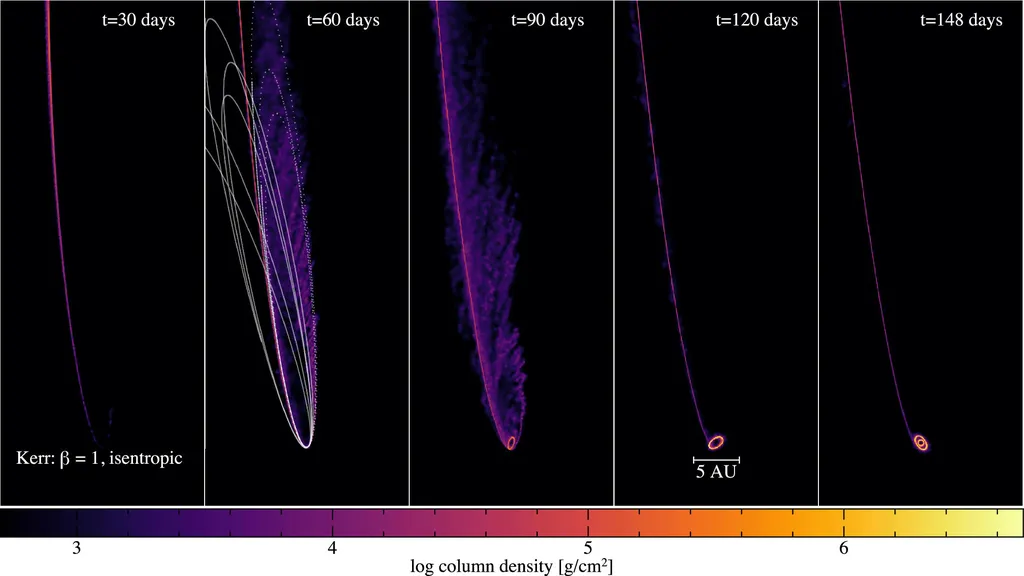
In the realm of astrophysics, researchers Di Wang and Fa-Yin Wang from the University of Science and Technology of China have been delving into the intricate dynamics of tidal capture and partial tidal disruption events (pTDEs), particularly focusing on giant stars. Their work, recently published in the Monthly Notices of the Royal Astronomical Society, offers new insights into the behavior of stars in the vicinity of supermassive black holes (SMBHs), which could have implications for understanding energy dynamics in extreme environments.
The researchers conducted hydrodynamic numerical simulations to study pTDEs involving giant stars. Their findings reveal that when a giant star undergoes a weaker disruption near an SMBH, the remnant material behaves similarly to that of main-sequence stars, gaining energy and potentially escaping the black hole’s grasp. However, as the disruption intensifies, the remnant material transitions from gaining energy to losing energy, leading to its capture by the SMBH. This behavior is distinct from that of main-sequence stars and highlights the significant role of the giant star’s compact core in the dynamical processes during pTDEs.
The study also found that the energy change of the remnant material is strongly correlated with asymmetric mass loss, specifically the difference in mass outflow between the Lagrange points L1 and L2. This conclusion aligns with previous studies on main-sequence stars but contradicts earlier models quantitatively, suggesting that the dynamical model of pTDEs needs further refinement.
The implications of this research extend beyond astrophysics. Understanding the dynamics of pTDEs can provide insights into the energy dynamics in extreme environments, which could be relevant for the energy sector. For instance, the study of repeating pTDEs and their observability could lead to the development of new methods for monitoring and predicting energy outputs in extreme environments, such as fusion reactors or advanced space propulsion systems. Additionally, the long-term orbital evolution of high eccentricity extreme mass ratio inspiral systems, as discussed in the study, could offer valuable insights into the stability and longevity of energy systems in space.
In summary, the work of Di Wang and Fa-Yin Wang sheds light on the complex dynamics of tidal capture and pTDEs involving giant stars. Their findings not only advance our understanding of astrophysical phenomena but also hold potential practical applications for the energy sector, particularly in the realm of extreme energy environments and space-based energy systems.
This article is based on research available at arXiv.