
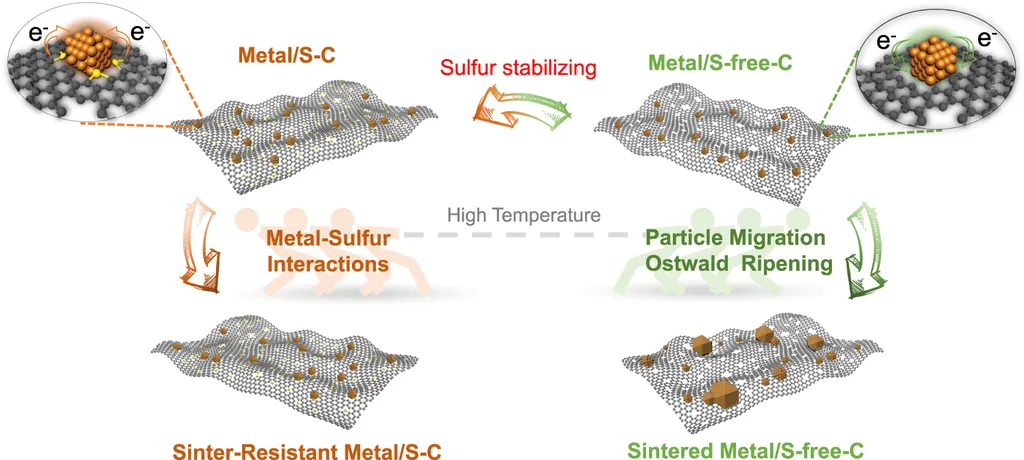
Researchers from the Federal University of Minas Gerais in Brazil have published a study in the Journal of Physical Chemistry C that sheds light on sulfur poisoning in transition-metal nanoclusters, which are crucial for various energy industry applications, including catalysis in fuel cells and chemical processing.
The team, led by Maurício J. Piotrowski, employed a combination of dispersion-corrected density functional theory (DFT) and physics-informed machine learning to investigate sulfur adsorption and poisoning mechanisms in 13-atom icosahedral clusters from 30 different transition metals. Their goal was to understand how sulfur interacts with these nanoclusters, which can significantly impact their performance in catalytic processes.
The researchers found that sulfur adsorption sites, thermodynamics, structural changes, and electronic properties vary across the different metals. They discovered that for most metals, the metal-sulfur interaction primarily determines adsorption energy, while structural distortion penalties can be significant for some metals, indicating a higher likelihood of restructuring upon sulfur adsorption.
Using unsupervised k-means clustering, the team identified periodic trends and grouped metals based on their adsorption responses. They also employed supervised regression models to pinpoint the descriptors that best predict adsorption for new samples. Notably, they highlighted the isoelectronic triad of titanium, zirconium, and hafnium as a balanced group that combines strong sulfur binding with minimal structural change.
The study also revealed that sulfur dioxide (SO2) adsorption is strong and tends toward dissociation on these clusters, linking electronic states, lattice response, and poisoning strength. These findings provide data-driven guidelines for designing sulfur-tolerant nanocatalysts at the subnanometer scale, which can enhance the durability and efficiency of catalytic processes in the energy sector.
In practical terms, this research can aid in the development of more robust and efficient catalysts for energy applications, such as fuel cells and chemical processing plants. By understanding and mitigating sulfur poisoning, the energy industry can improve the performance and longevity of these critical components, leading to more sustainable and cost-effective energy solutions.
This article is based on research available at arXiv.