
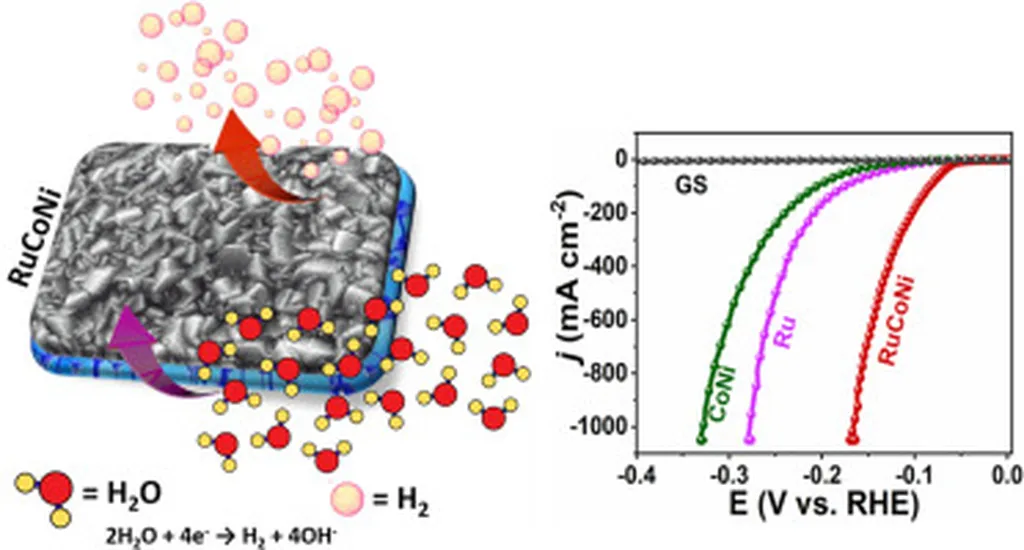
In the realm of energy research, a team of scientists from Ruhr University Bochum, Germany, has been delving into the intricate world of compositionally complex solid solutions (CCSSs) to enhance electrocatalytic activity. This interdisciplinary group, led by Professor Miran Joo and including researchers like Huixin Xiu, Sabrina Baha, and others, has been exploring how varying the content of ruthenium (Ru) in gold-palladium-platinum-ruthenium (Au-Pd-Pt-Ru) thin films can influence their electrocatalytic properties and defect formation. Their findings, published in the journal Advanced Energy Materials, offer promising insights for the energy industry, particularly in the development of more efficient electrocatalysts for processes like hydrogen evolution.
The researchers fabricated a thin-film material library with a wide range of compositions using room-temperature combinatorial co-sputtering. This library allowed them to systematically investigate the effects of Ru content on the electrochemistry and defect formation in Au-Pd-Pt-Ru CCSS thin films. They employed high-throughput characterization techniques, including electron microscopy, X-ray diffraction, and electrochemical screening, to correlate composition and microstructural features with catalytic activity.
Three representative compositions from the library—Au68Pd13Pt15Ru4, Au27Pd24Pt23Ru26, and Au9Pd21Pt18Ru52—were selected for detailed examination. All three samples exhibited face-centered cubic structures, with lattice contraction observed as Ru content increased. Interestingly, the researchers noted a transition from a high density of nanotwins to high-density, atomic-layer stacking faults with increasing Ru content. This structural evolution was accompanied by an improvement in hydrogen evolution reaction activity, suggesting that higher Ru content enhances catalytic performance.
The study also revealed local compositional fluctuations, including element-specific enrichment and depletion at grain boundaries, through atom probe tomography. These findings provide valuable insights into the design of surface atom arrangements in CCSS electrocatalysts, potentially leading to enhanced performance and more efficient energy conversion processes. The practical applications of this research could extend to various energy technologies, including fuel cells, electrolyzers, and other electrochemical devices, where efficient and durable electrocatalysts are crucial for optimal performance.
In summary, the work of Joo and his team highlights the importance of understanding and controlling the composition and microstructure of complex solid solutions to tailor their electrocatalytic properties. By optimizing these parameters, the energy industry can develop more effective and efficient electrocatalysts, contributing to the advancement of clean and sustainable energy technologies. The research was published in the journal Advanced Energy Materials, offering a robust foundation for further exploration and application in the field of energy conversion and storage.
This article is based on research available at arXiv.