
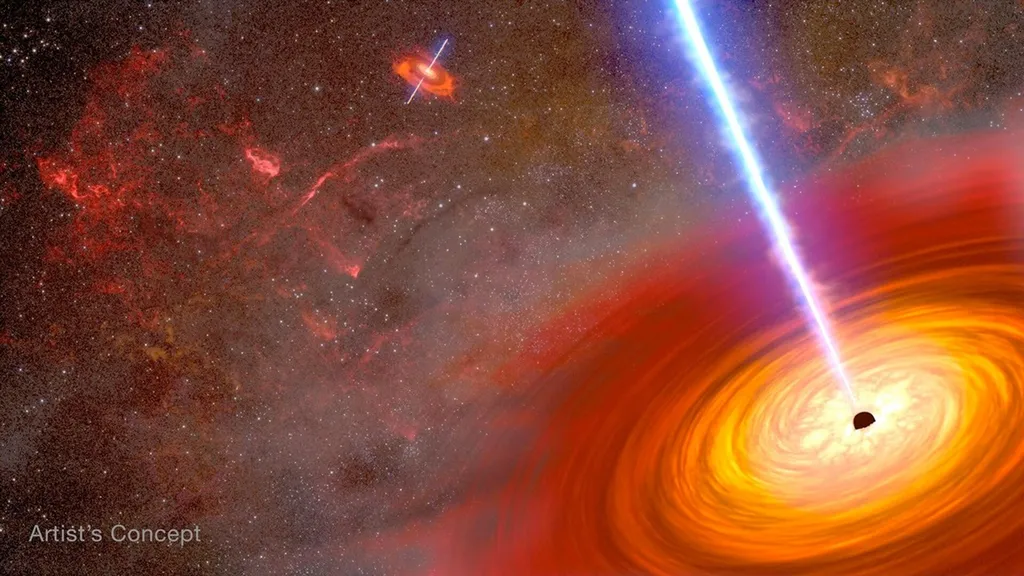
In the realm of astrophysics and energy research, a trio of scientists from Vanderbilt University— Siyuan Chen, Karan Jani, and Thomas W. Kephart—have delved into the intriguing world of black holes and their role in the universe’s entropy budget. Their work, recently published in the journal Physical Review D, offers new insights into the thermodynamic history of our cosmos, with potential implications for our understanding of dark matter and the early universe.
Black holes are known to be the most entropy-rich objects in the observable universe. Entropy, a measure of disorder or randomness, is a key concept in thermodynamics, and black holes, with their immense gravitational pull, are thought to contain more of it than any other cosmic entity. The researchers focused on black holes in the stellar to lite-intermediate-mass range, originating from either supernovae or binary mergers. They utilized population synthesis models and numerical relativity to update the cosmological entropy budget for these black holes.
The study reveals three main insights. Firstly, the cumulative entropy from merging black holes surpasses the total entropy from cosmic microwave background photons around the onset of the Over-massive Black Hole Galaxy phase at a redshift of approximately 12. This suggests that black hole mergers played a more significant role in shaping the thermodynamic state of the early universe than relic radiation. Secondly, if primordial black holes constitute a nonzero fraction of dark matter, their early binary mergers could establish an “entropy floor” in the Dark Ages, potentially dominating the cumulative merger-generated entropy history even for small abundances. Thirdly, the researchers highlight the thermodynamic asymmetry in black hole mergers, noting that the production of gravitational-wave energy is inefficient compared to the immense generation of Bekenstein-Hawking entropy.
While this research is primarily astrophysical in nature, it has potential implications for the energy sector, particularly in the realm of theoretical physics and energy generation. Understanding the thermodynamic properties of black holes and their role in the universe’s entropy budget could provide insights into the fundamental laws of physics, which in turn could inform the development of new energy technologies. However, it’s important to note that these applications are speculative and far from immediate.
In conclusion, the work of Chen, Jani, and Kephart offers a fascinating glimpse into the thermodynamic history of our universe, with potential implications for our understanding of dark matter and the early cosmos. While the practical applications for the energy sector are not yet clear, the study underscores the importance of fundamental research in advancing our knowledge of the universe and its underlying physical laws.
This article is based on research available at arXiv.