
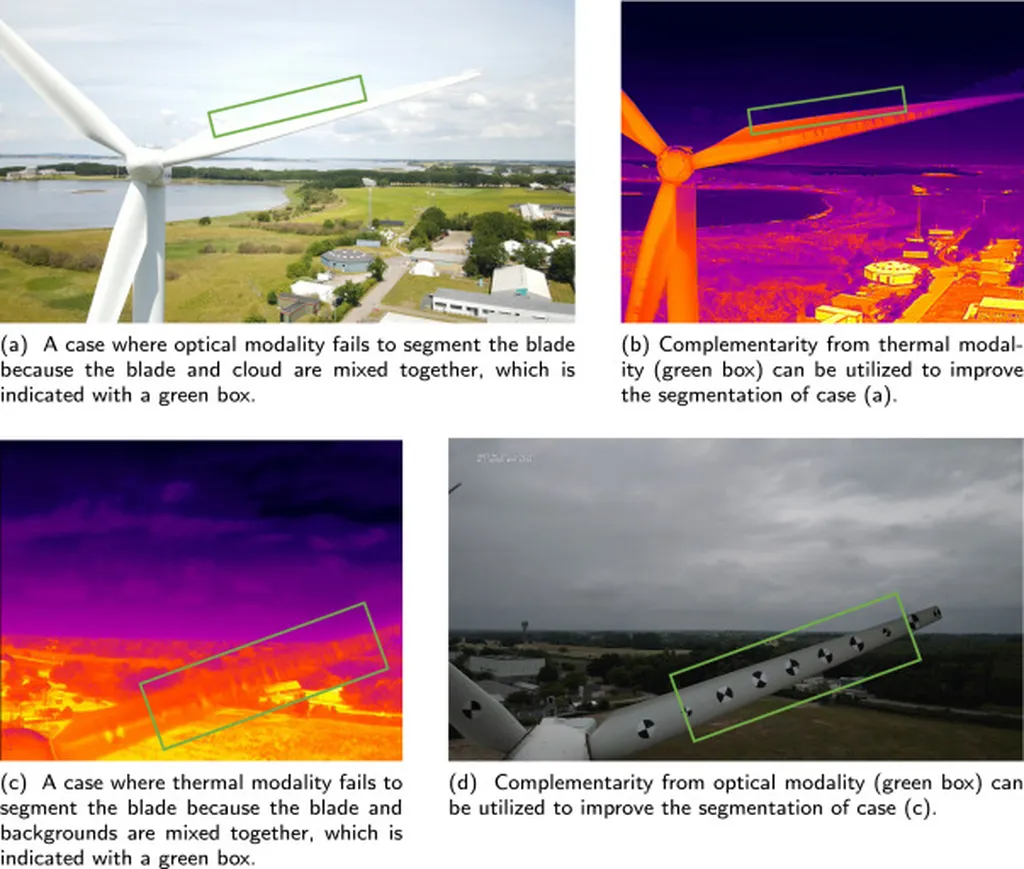
Researchers Raül Pérez-Gonzalo, Andreas Espersen, and Antonio Agudo, affiliated with the Technical University of Denmark, have developed a novel approach to improve the segmentation of wind turbine blades in images. Their work, titled “Probabilistic Deep Discriminant Analysis for Wind Blade Segmentation,” was published in the journal IEEE Transactions on Pattern Analysis and Machine Intelligence.
The team’s research addresses a challenge in machine learning known as discriminant analysis, which aims to improve the separability of different classes or categories in data. Traditional methods, like linear discriminant analysis, work well when data can be separated by straight lines or planes. However, they struggle with more complex, non-linear data. To tackle this, the researchers introduced a method called Deep Discriminant Analysis (DDA), which uses deep learning networks to optimize a mathematical criterion for class separability.
To ensure stable and efficient training of their deep learning model, the researchers incorporated several modifications. They used a technique called signed between-class variance, bound the model’s outputs with a sigmoid function, and converted multiplicative relationships into additive ones. These adjustments helped to avoid computational instabilities and improve the model’s performance. The researchers then developed two stable DDA loss functions and enhanced them with a probability loss, resulting in a method called Probabilistic DDA (PDDA).
PDDA is designed to minimize the overlap between different classes in the model’s output distributions, leading to more confident predictions and reduced variability within each class. When applied to the task of wind blade segmentation, PDDA demonstrated significant improvements in performance and consistency compared to existing methods. This is a notable advancement, as accurate segmentation of wind turbine blades is crucial for effective maintenance and monitoring in the wind energy sector.
The researchers highlight that their work represents the first application of DDA to image segmentation, opening up new possibilities for the use of deep learning in various image analysis tasks. For the energy industry, this research could lead to more efficient and reliable methods for inspecting and maintaining wind turbines, ultimately contributing to the growth and sustainability of wind energy as a key player in the renewable energy mix.
This article is based on research available at arXiv.