
In the realm of energy and signal processing, understanding and mitigating spectral interference is crucial for accurate data analysis. Researchers Shrikant Chand, James Nolen, and Hau-Tieng Wu from the University of South Carolina have delved into this topic, focusing on the short-time Fourier transform (STFT) and its nonlinear refinements, particularly the synchrosqueezing transform (SST). Their work, published in the journal “Applied and Computational Harmonic Analysis,” offers insights that could benefit the energy sector by improving signal processing techniques used in various applications.
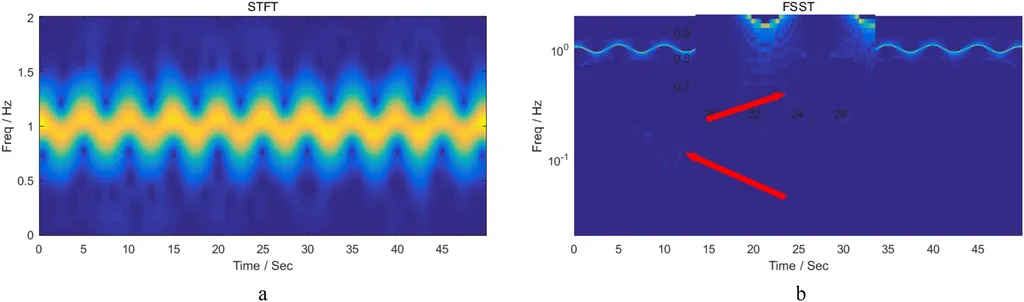
Spectral interference, akin to the beating phenomenon in the time domain, can distort time-frequency representations (TFRs) in physical applications. The researchers studied this phenomenon using a two-component harmonic model to quantify when STFT can resolve two nearby frequencies. They found a critical gap that scales inversely to kernel bandwidth and depends on the amplitude ratio. Below this threshold, the spectrogram ridges undergo bifurcation, forming repeating time-frequency bubbles that can be approximated by ellipses in the balanced-amplitude case.
The study also analyzed the STFT phase, revealing a canonical winding behavior. The researchers related the complex-valued SST reassignment map to a holomorphic structure via the Bargmann transform. In the two-component setting, the reassignment rule admits an explicit Mobius-geometry description, sending frequency lines to circular arcs in the complex plane.
Viewing SST and reassignment through a measure mapping perspective, the researchers derived small-kernel asymptotics. This explains when reassignment sharpens energy and when it produces distorted or misleading TFRs. They also introduced a generalized synchrosqueezing framework that isolates the role of STFT weighting. This framework clarifies how alternative choices can mitigate interference in certain regimes, offering practical applications for the energy sector.
By improving the accuracy of time-frequency representations, this research can enhance signal processing in various energy applications, such as seismic data analysis, power quality monitoring, and renewable energy integration. Accurate signal processing is essential for optimizing energy systems, predicting maintenance needs, and ensuring the reliable operation of energy infrastructure.
Source: Chand, S., Nolen, J., & Wu, H.-T. (2023). On spectral interference of the short-time Fourier transform and its nonlinear variations. Applied and Computational Harmonic Analysis.
This article is based on research available at arXiv.