
Researchers from Eindhoven University of Technology, including Viren Tyagi, Mike Pols, Geert Brocks, and Shuxia Tao, have recently published a study in the journal Physical Chemistry Chemical Physics that sheds light on the behavior of halide ions in perovskite materials, which are of great interest in the energy sector for their potential use in solar cells and other applications.
The study focuses on the diffusion of halide vacancies and interstitials in mixed-halide perovskites, specifically CsPb(IxBr1-x)3, and in heterojunctions between CsPbI3 and CsPbBr3. The researchers used molecular dynamics simulations, employing neural network potentials trained on density functional theory calculations, to investigate these phenomena.
The researchers found that both vacancies and interstitials diffuse more readily in mixed-halide perovskites compared to single-halide perovskites. Moreover, they observed a difference in mobility between bromine (Br) and iodine (I) ions in the mixed compound. When it comes to heterojunctions, the interface structure plays a crucial role in governing diffusion. A bromine-rich interface, for instance, blocks the migration of vacancies, while an iodine-rich interface is more permeable.
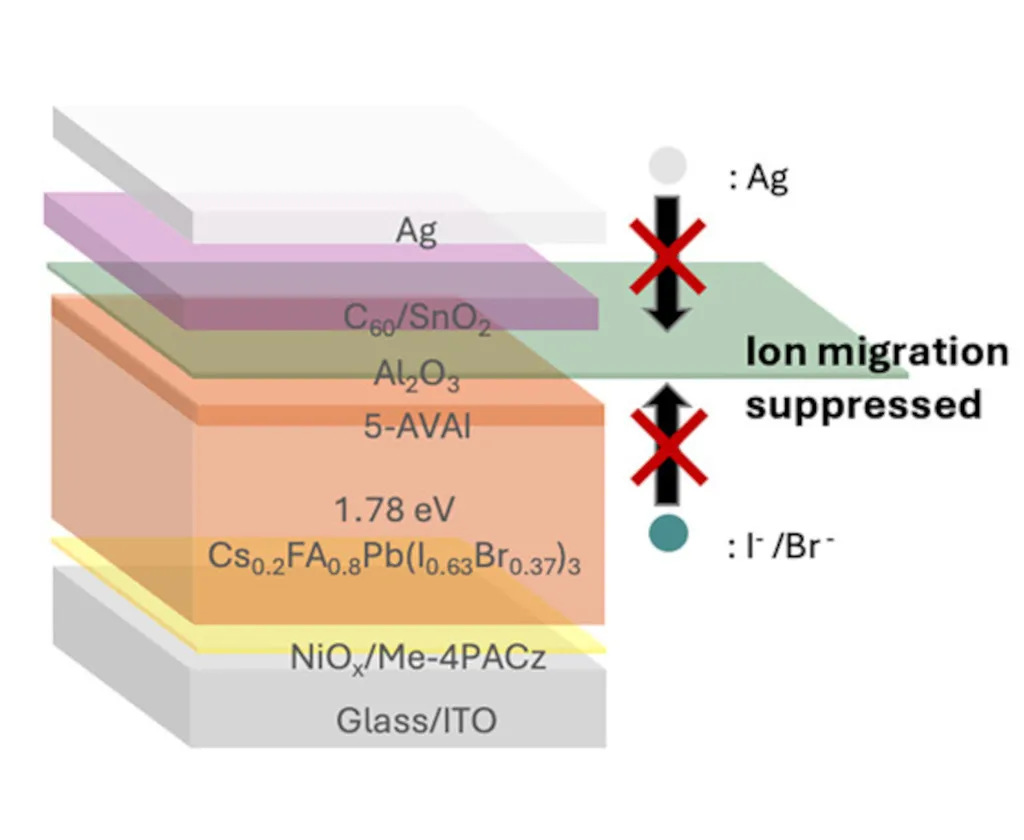
These findings have practical implications for the energy sector, particularly in the development of perovskite solar cells. Understanding and controlling halide diffusion is essential for improving the stability and efficiency of these devices. For instance, the observed differences in ion mobility could be harnessed to design perovskite materials with enhanced performance. Furthermore, the insights into heterojunction interfaces could guide the development of more effective strategies for constructing tandem solar cells, which combine multiple layers of light-absorbing materials to achieve higher efficiencies.
In summary, this research provides valuable insights into the behavior of halide ions in perovskite materials, with potential applications in the energy sector. By better understanding and controlling halide diffusion, researchers can work towards developing more stable and efficient perovskite solar cells and other energy technologies.
This article is based on research available at arXiv.