
Researchers Asher Berlin, Dawid Brzeminski, and Erwin H. Tanin, affiliated with the University of Florida, have published a study in the journal Physical Review D that explores the potential sources of high-frequency gravitational waves. Their work aims to narrow down the sources of these waves, which could have significant implications for our understanding of the universe and potentially the energy sector.
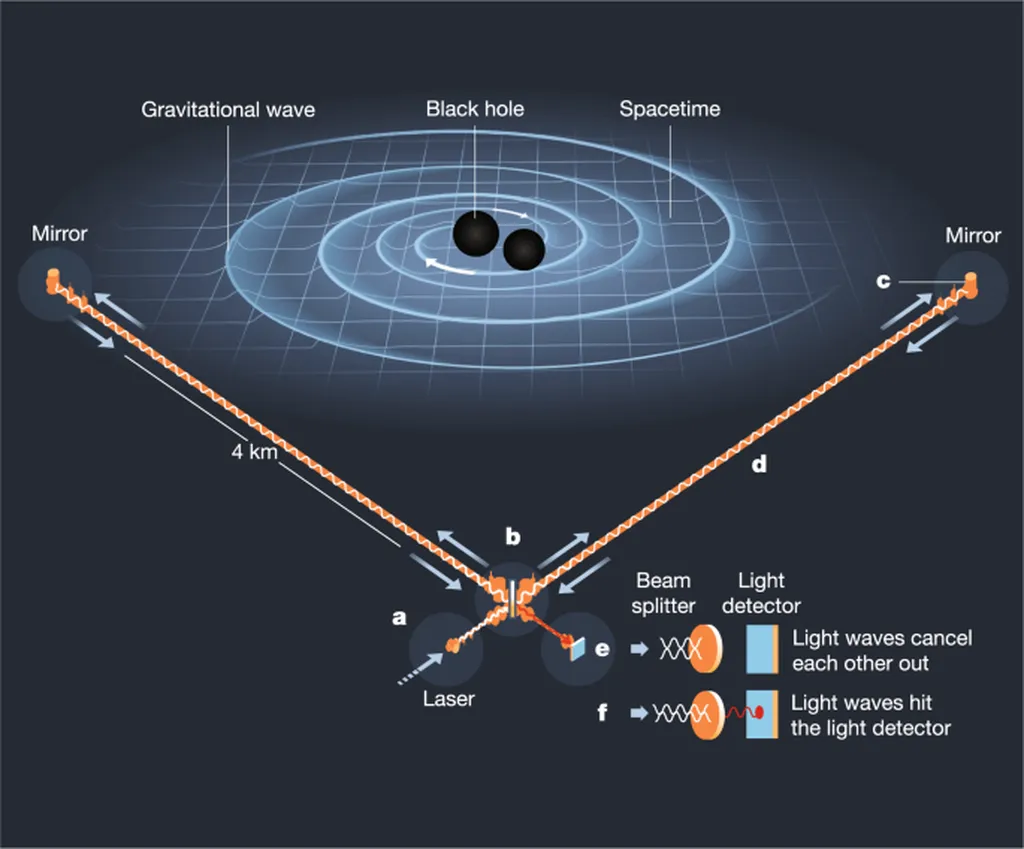
Gravitational waves are ripples in spacetime that are typically produced by massive, accelerating objects, such as merging black holes or neutron stars. While current detectors, like LIGO and Virgo, are sensitive to gravitational waves in the frequency range of 10 Hz to 10 kHz, detecting waves above 100 kHz would be a groundbreaking discovery. Such high-frequency waves would likely originate from new physics within the late universe, as the known sources of gravitational waves do not produce waves at these frequencies.
The researchers argue that energy conservation implies that gravitational waves detectable by future experiments above a MHz would most likely originate from within the Solar System. This is because the energy required to produce such high-frequency waves from distant sources would be extraordinarily high, making it unlikely. By focusing on sources within the Solar System, the researchers narrow down the search area and provide a more manageable landscape for future experiments.
The study also highlights the most interesting parts of theory space for high-frequency gravitational waves, while remaining agnostic of the specific signal mechanism. This model-independent approach allows the researchers to constrain the physical properties of potential sources, providing valuable guidance for future experiments.
In terms of practical applications for the energy sector, the detection of high-frequency gravitational waves could potentially lead to new technologies for energy generation or transmission. For example, if the sources of these waves can be harnessed or controlled, they could provide a new, clean, and virtually limitless source of energy. Additionally, the study of high-frequency gravitational waves could lead to a better understanding of the fundamental laws of physics, which could have implications for various energy technologies.
In conclusion, the research by Berlin, Brzeminski, and Tanin provides a valuable roadmap for the search for high-frequency gravitational waves, narrowing down the potential sources and highlighting the most promising avenues for future experiments. While the practical applications for the energy sector are still speculative, the potential benefits are significant and warrant further investigation. The study was published in Physical Review D, a peer-reviewed journal published by the American Physical Society.
This article is based on research available at arXiv.