
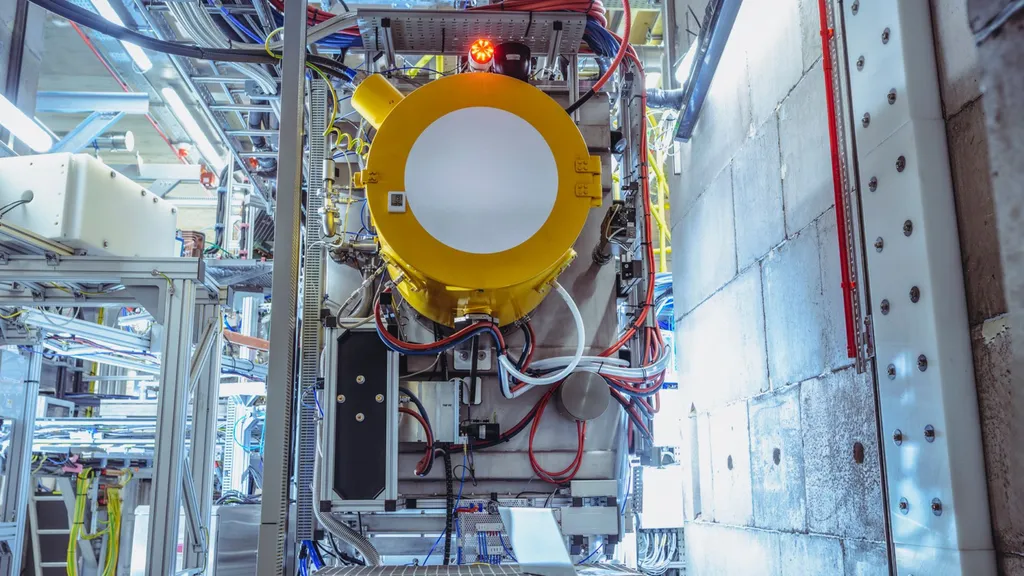
In the realm of energy research, scientists are continually pushing the boundaries of fusion energy, a promising clean energy source that mimics the processes powering the sun. A team of researchers from Southwest Jiaotong University, led by Dr. Shen Yong, has been investigating the behavior of circular cross-section plasmas in the HL-2A tokamak, a device used to confine hot plasma with magnetic fields to facilitate fusion reactions.
The researchers focused on understanding the magnetohydrodynamic (MHD) equilibrium and stability of these plasmas, which are fundamental to magnetic confinement fusion experiments. Their findings, published in the journal Physics of Plasmas, provide valuable insights into the operational limits of tokamak plasmas, which can inform the development of future fusion power plants.
The team found that when the central safety factor, a measure of the plasma’s stability, is around 0.95, the plasma is prone to an internal kink mode, a type of instability. As the plasma’s beta (the ratio of thermal pressure to magnetic pressure) increases, external kink modes can also appear. The combination of the central and edge safety factors determines the plasma’s equilibrium configuration and affects its MHD stability. The researchers discovered that under certain conditions, specifically when the edge safety factor is greater than 2 and the central safety factor is slightly above 1, both internal and surface kink modes can be stabilized.
However, as the central safety factor increases beyond 1, the plasma becomes unstable again, and the intensity of the instability grows. The researchers also observed that as the poloidal beta (a measure of the plasma pressure) increases, the MHD instability develops, and the equilibrium configuration of the plasma elongates laterally. This elongation has a stabilizing effect on the plasma, suppressing the instability.
The team’s calculations showed that the maximum beta value imposed by the ideal MHD mode in a plasma with a free boundary in tokamak experiments is proportional to the normalized current. The achievable maximum beta was calibrated to be approximately 2.01 times the normalized current. For the HL-2A tokamak, the operational beta limit for circular cross-section plasma is around 2.0. The researchers also found that a high central safety factor is not conducive to MHD stability and leads to a decrease in the beta limit value. When the central safety factor is 1.3, the maximum normalized beta value obtained is approximately 1.8.
These findings provide a deeper understanding of the operational limits of tokamak plasmas and can guide the development of future fusion power plants. By optimizing the safety factors and beta values, researchers can work towards achieving stable, high-performance plasmas that are essential for practical fusion energy generation. As the world seeks clean, sustainable energy sources, research like this brings us one step closer to harnessing the power of fusion.
This article is based on research available at arXiv.