
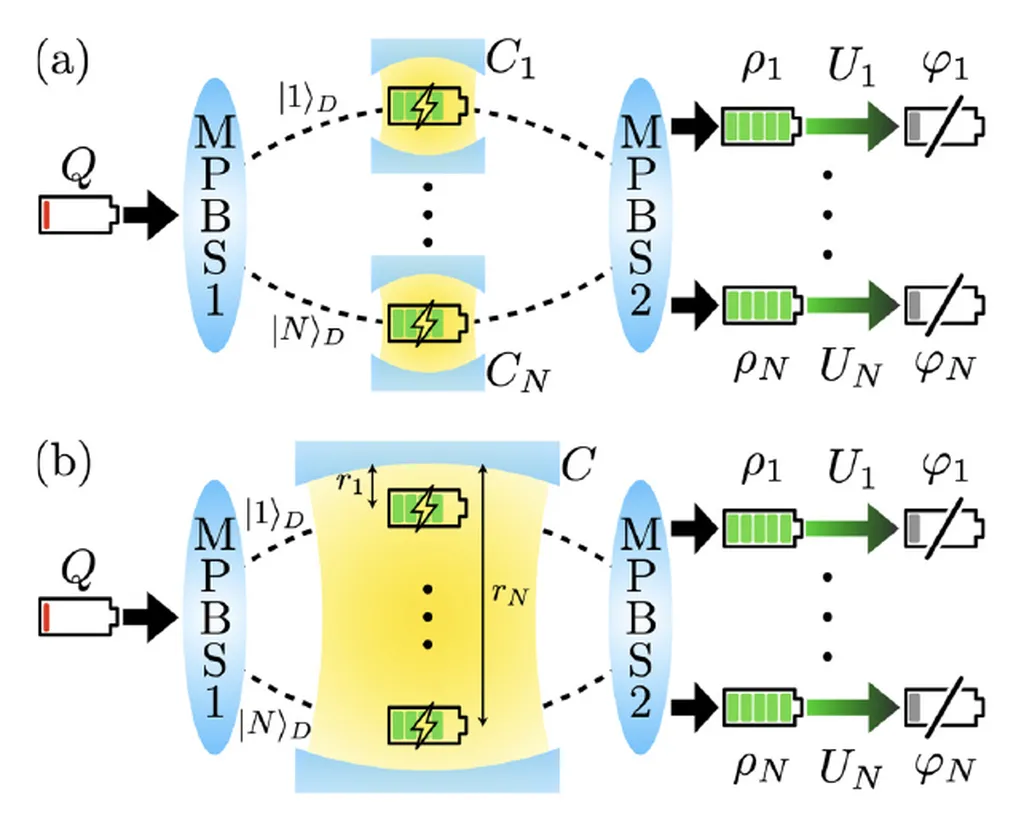
Researchers Christopher Downing and Mohammad Ukhtary, affiliated with the University of Oxford, have delved into the fascinating realm of quantum energetics and thermodynamics, specifically focusing on the charging process of a simple quantum battery model. Their work, published in the journal Physical Review E, offers a fresh perspective on how quantum batteries can be charged and the factors that influence their performance.
In their study, Downing and Ukhtary revisited the fundamentals of quantum battery charging, using a model composed of a charger qubit and a single-cell battery qubit. They allowed the initial state of the charger to be any point on the surface of the Bloch sphere, a geometrical representation used to describe the state of a two-level quantum system. This approach enabled them to derive generalized analytical expressions for the stored energy, ergotropy (the maximum work that can be extracted from a quantum system), and capacity of the battery.
The researchers found that these expressions depend on the initial Bloch sphere polar angle in a way that is reminiscent of the quantum area theorem. This dependence highlights the role of quantum coherences and population inversions in generating ergotropy and battery capacity. Quantum coherences refer to the superposition of quantum states, while population inversions occur when more particles are in a higher energy state than in a lower energy state, a phenomenon often exploited in lasers.
Importantly, Downing and Ukhtary discovered that the ergotropic charging power and its associated optimal charging time deviate notably from standard results that do not take thermodynamic considerations into account. This finding underscores the importance of incorporating thermodynamic principles into the design and analysis of quantum batteries.
From an energy industry perspective, this research contributes to the growing field of quantum energy science, which aims to harness the unique properties of quantum systems for energy storage and conversion. While practical applications of quantum batteries are still in the early stages of development, the insights gained from this study could guide future experiments and theoretical work. As our understanding of quantum energetics and thermodynamics continues to evolve, it may pave the way for innovative energy storage solutions that could potentially revolutionize the energy sector.
Source: Downing, C. A., & Ukhtary, M. S. (2023). Charging a quantum battery from the Bloch sphere. Physical Review E, 107(2), 024112.
This article is based on research available at arXiv.