
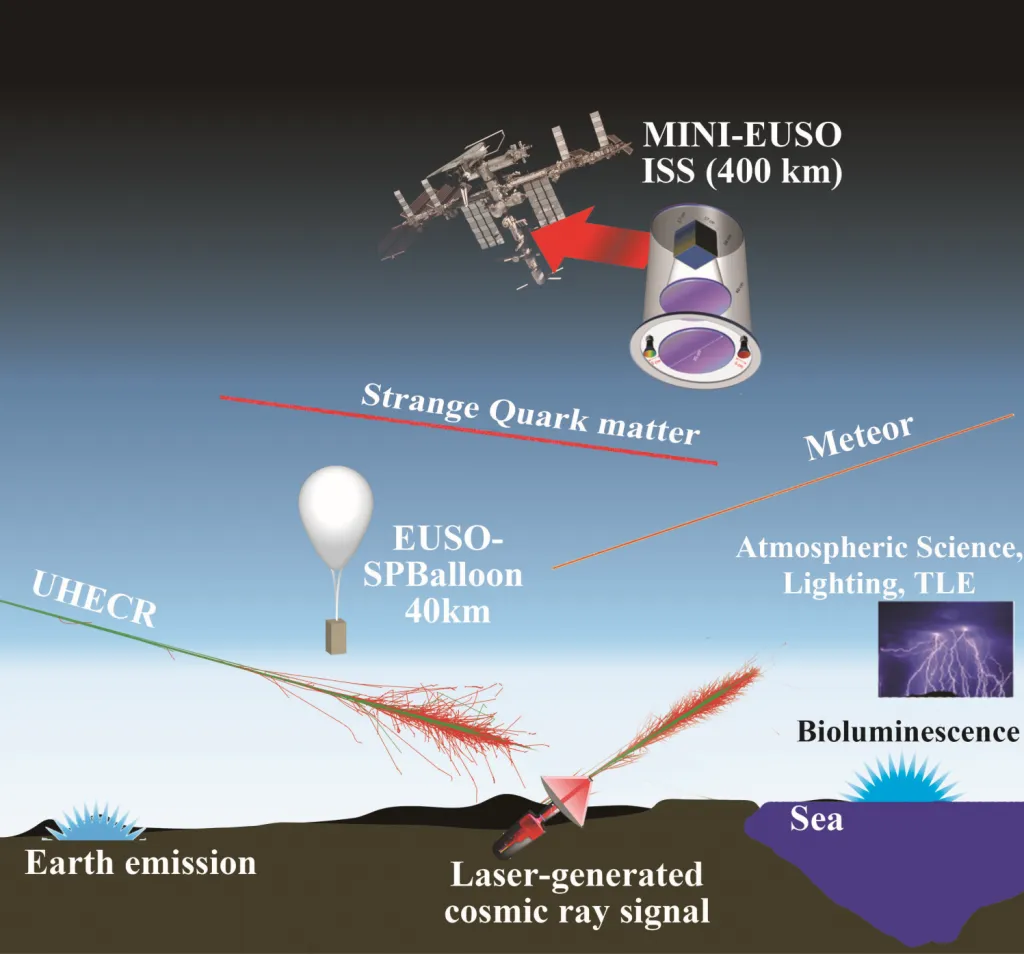
Matteo Battisti, a researcher affiliated with the JEM-EUSO program, has led a significant study on the Mini-EUSO mission, which has been operational on the International Space Station (ISS) since October 2019. The mission’s primary goal is to search for Ultra-High Energy Cosmic Rays (UHECRs) and to better understand various atmospheric phenomena. The research was published in a recent issue of the Journal of Cosmic Research.
Over the past five years, Mini-EUSO has completed more than 150 observation sessions, accumulating approximately 750 hours of data. This extensive data collection has enabled the creation of the first global UV emission maps of Earth, providing valuable insights into natural and artificial light sources, as well as meteor activity. The mission has conducted the first systematic space-based meteor survey, detecting over 22,000 meteors and identifying three potential interstellar candidates. This information can be crucial for understanding the composition and behavior of meteors, which can impact satellite operations and space debris management.
One of the most intriguing aspects of the Mini-EUSO mission is its observation of Transient Luminous Events (TLEs), particularly elves. These are expanding ring-shaped structures that occur at high altitudes and are associated with lightning activity. Mini-EUSO has detected elves with varying structures, including single-ring up to five-ring formations. The mission’s unique imaging capabilities, fast time resolution, and observational geometry have provided unprecedented insights into the dynamics of these phenomena. Understanding elves and other TLEs can help improve atmospheric modeling and lightning prediction, which are essential for the safe operation of aircraft and satellites.
Additionally, Mini-EUSO has demonstrated the ability to identify short light transients that resemble extensive air shower signals, distinguishing them from those produced by UHECRs. This capability is crucial for future space-based UHECR observatories, as it ensures accurate data interpretation and minimizes false positives. The mission’s success paves the way for more advanced detectors and a deeper understanding of the extreme energy universe.
In summary, the Mini-EUSO mission has made significant strides in cosmic ray detection and atmospheric phenomena observation. Its findings have practical applications for the energy sector, particularly in improving atmospheric modeling and lightning prediction, which are vital for the safe and efficient operation of energy infrastructure. The mission’s success highlights the potential of space-based detectors in advancing our understanding of the universe and its impact on Earth.
This article is based on research available at arXiv.