
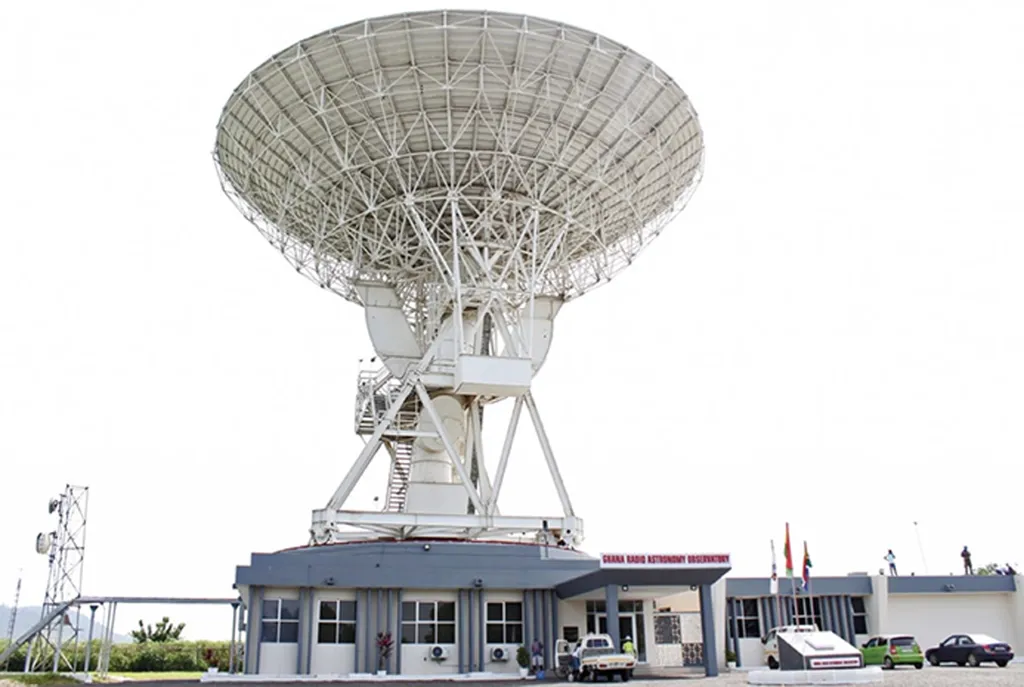
In a significant stride for African astronomy, a team of researchers led by Emmanuel Proven-Adzri from the Ghana Space Science and Technology Institute, along with colleagues from various institutions, has successfully converted a decommissioned satellite communication antenna into a fully operational radio telescope. This project, known as the Ghana Radio Astronomy Observatory (GRAO), is poised to enhance Africa’s capabilities in radio astronomy and contribute to global astronomical research.
The Ghana Radio Astronomy Observatory, located near the equator at Kutunse, Ghana, has been transformed into a scientifically capable Very Long Baseline Interferometry (VLBI)-ready radio telescope. The facility’s strategic location offers nearly full-sky coverage, making it an invaluable asset for various astronomical observations and global VLBI networks. The research, published in the journal Astronomy & Astrophysics, documents the technical advancements and upgrades made to the facility, including the installation of beam-waveguide optics, dual-polarization C-band receivers, and a hydrogen maser for precise timing.
The team of researchers, which includes Nia Imara, Theophilus Ansah-Narh, Wonder Sewavi, Diana Klutse, Evaristus Iyida, Joseph Bremang Tandoh, Naomi Asabre Frimpong, Benedicta Woode, and Pieter Pretorius, has successfully conducted early science observations. These include high-resolution spectral-line observations of 6.7 GHz Class II methanol masers, pulse timing of PSR J0835-4510 (Vela), and successful VLBI fringe detections on intercontinental baselines. The simulations and commissioning tests have confirmed high aperture efficiency, low sidelobe levels, and robust time stability across the signal chain, validating the GRAO’s readiness for both standalone and networked operations.
For the energy sector, the practical applications of this research may not be immediately apparent, but the advancements in radio astronomy can indirectly benefit the industry. The development of advanced receiver technologies and signal processing techniques can be adapted for use in satellite communication and remote sensing applications, which are crucial for monitoring and managing energy infrastructure. Additionally, the capacity building and technological advancements driven by the GRAO can contribute to the development of a skilled workforce capable of supporting the energy sector’s technological needs.
The successful transformation of the GRAO into a functional radio telescope highlights the potential for repurposing decommissioned infrastructure for scientific research. This approach can be explored in the energy sector to find innovative solutions for decommissioned energy facilities, promoting sustainability and cost-effectiveness. The GRAO’s integration into the African VLBI Network and its potential contributions to the Square Kilometre Array project underscore the importance of international collaboration in advancing scientific research and technological development.
This article is based on research available at arXiv.