
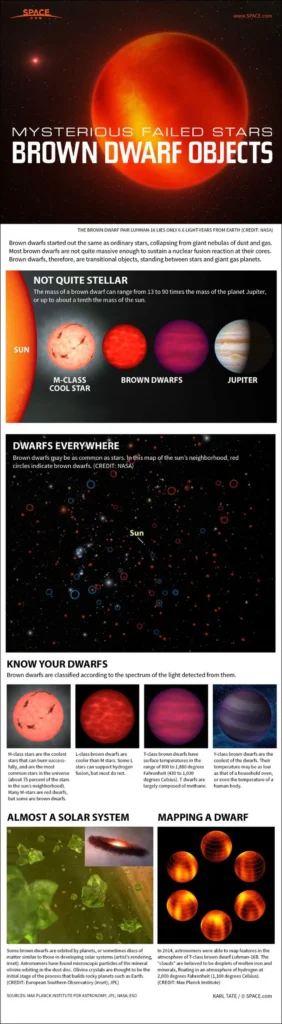
In the vast cosmos of astrophysics research, a team of scientists from the University of California, Santa Cruz, and the University of Texas at Austin, led by Jaime Luisi, has been delving into the intriguing world of brown dwarfs and their potential evolution into low-mass stars. Their work, published in the Astrophysical Journal, offers a fresh perspective on these celestial objects and their significance in understanding stellar evolution.
Brown dwarfs are often referred to as “failed stars” because they lack the mass to ignite nuclear fusion of hydrogen into helium, which is the defining characteristic of main-sequence stars. However, the researchers have found that some brown dwarfs can gain mass through binary interactions, potentially pushing them above the hydrogen burning limit (HBL) and altering their evolutionary path.
The team used MESA simulations to study the evolution of these objects. They discovered that a subset of brown dwarfs that gain enough mass to eventually become stars experience an extended luminosity plateau. During this phase, which can last for hundreds of millions to billions of years, the surface luminosity of these objects remains nearly constant. This plateau is a result of the time it takes for the core of the object to reheat sufficiently to sustain convection and initiate stable hydrogen burning.
The researchers also found that not all brown dwarfs that gain mass will successfully transition into low-mass stars. Some will remain brown dwarf-like, unable to burn hydrogen at a rate high enough to power their surface luminosity. These objects, along with those experiencing the luminosity plateau, occupy a unique space in a mass-luminosity diagram. This unique positioning could provide valuable insights into binary mass transfer physics and help astronomers better understand the complex processes involved in stellar evolution.
For the energy sector, this research might seem far removed, but it underscores the importance of understanding the fundamental processes that govern star formation and evolution. Stars are the ultimate source of energy in the universe, and studying their life cycles can provide insights into the long-term energy dynamics of the cosmos. Moreover, the advanced computational models used in this study, such as MESA, can be adapted and applied to other areas of energy research, including nuclear fusion and stellar energy harvesting technologies.
In summary, the work of Luisi and his colleagues offers a nuanced look at the evolution of brown dwarfs and their potential transition into low-mass stars. Their findings not only expand our understanding of stellar evolution but also highlight the importance of advanced computational models in exploring the complexities of the universe. As we continue to seek sustainable and efficient energy sources, the lessons learned from studying the stars can inspire and inform our efforts here on Earth.
This article is based on research available at arXiv.