
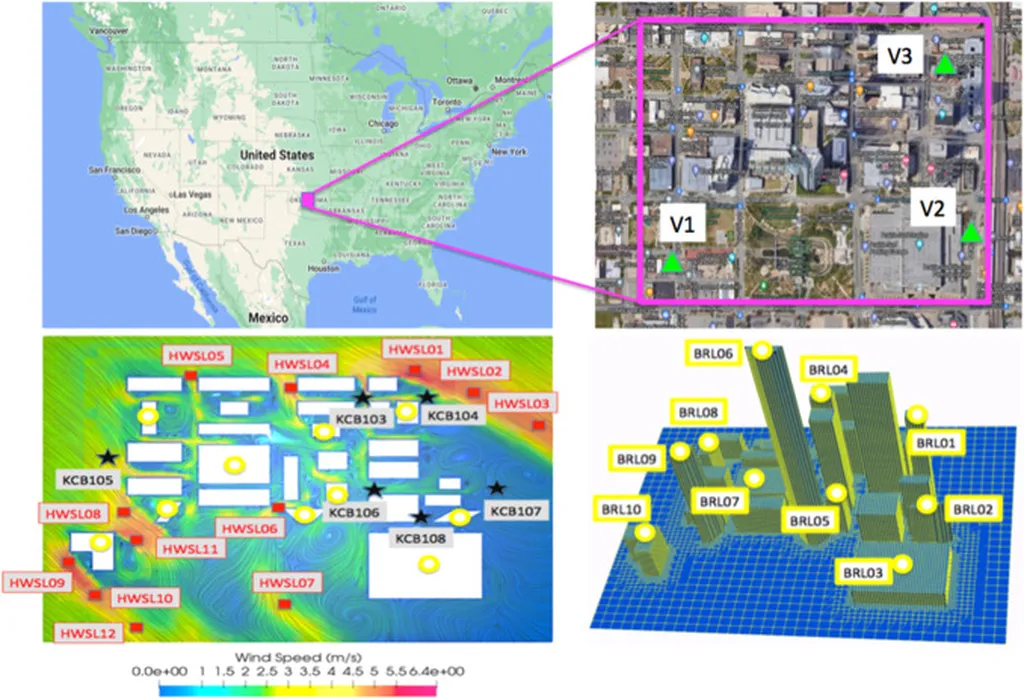
Researchers Francisco Giral, Álvaro Manzano, Ignacio Gómez, Ricardo Vinuesa, and Soledad Le Clainche, affiliated with the University of Bristol, have developed a novel framework aimed at improving urban wind flow reconstruction. Their work, published in the journal Nature Computational Science, addresses a critical need in environmental monitoring and urban planning.
Urban wind flow reconstruction is vital for assessing air quality, heat dispersion, and pedestrian comfort. However, this task is challenging when only sparse sensor data are available. The researchers propose GenDA, a generative data assimilation framework that reconstructs high-resolution wind fields on unstructured meshes from limited observations. This approach employs a multiscale graph-based diffusion architecture trained on computational fluid dynamics (CFD) simulations.
GenDA interprets classifier-free guidance as a learned posterior reconstruction mechanism. The unconditional branch of the model learns a geometry-aware flow prior, while the sensor-conditioned branch injects observational constraints during sampling. This dual approach enables obstacle-aware reconstruction and generalization across unseen geometries, wind directions, and mesh resolutions without the need for retraining. The framework is versatile, accommodating both sparse fixed sensors and trajectory-based observations using the same reconstruction procedure.
When evaluated against supervised graph neural network (GNN) baselines and classical reduced-order data assimilation methods, GenDA demonstrated significant improvements. It reduced the relative root-mean-square error (RRMSE) by 25-57% and increased the structural similarity index (SSIM) by 23-33% across the tested meshes. The experiments were conducted on Reynolds-averaged Navier-Stokes (RANS) simulations of a real urban neighborhood in Bristol, United Kingdom, featuring complex building geometry and irregular terrain.
For the energy sector, this research offers practical applications in urban wind energy assessment and optimization. Accurate wind flow reconstruction can enhance the placement and efficiency of urban wind turbines, contributing to renewable energy goals. Additionally, improved air quality and heat dispersion modeling can inform better urban planning and infrastructure development, supporting sustainable energy practices.
The researchers’ work provides a scalable path toward generative, geometry-aware data assimilation for environmental monitoring in complex domains. This advancement could significantly impact the energy industry by enabling more precise and efficient urban wind energy solutions.
This article is based on research available at arXiv.