
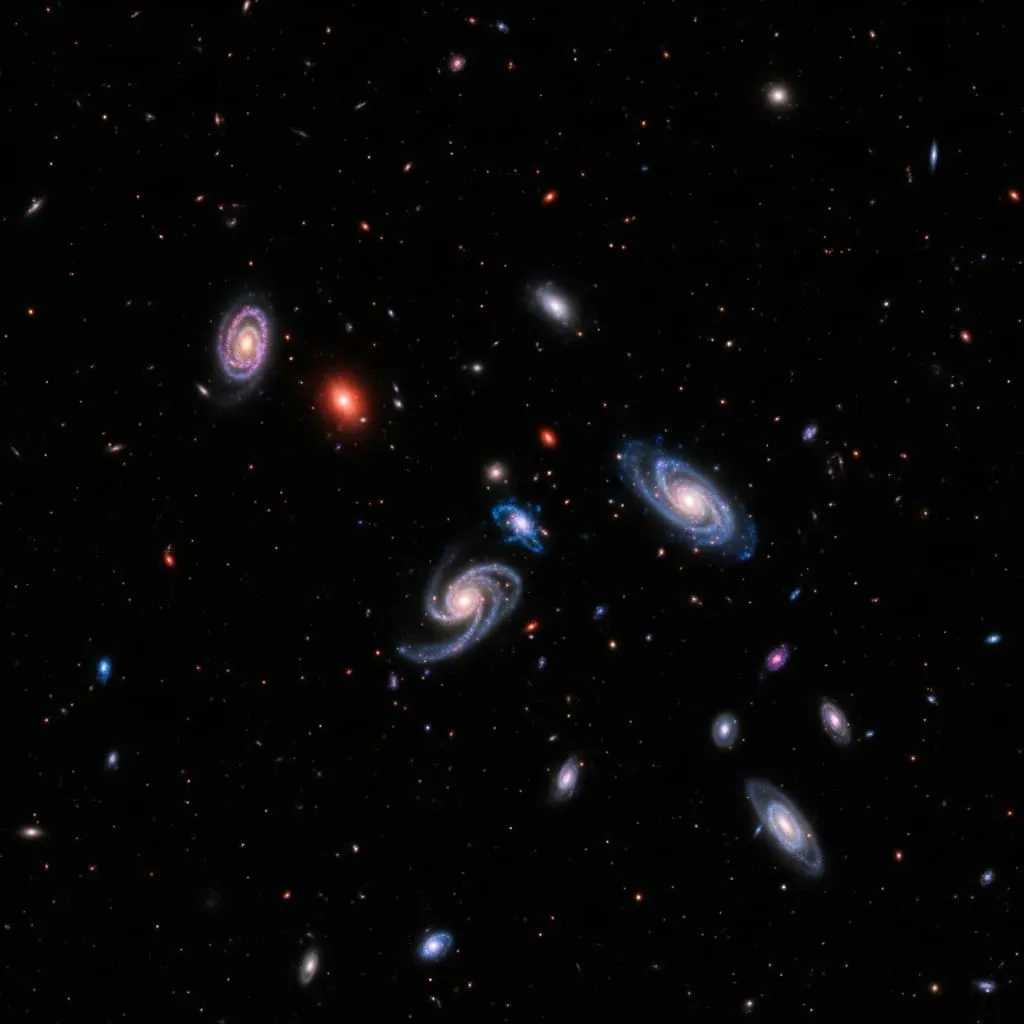
In a recent study, a team of researchers led by Qianqiao Zhou from the University of Arizona, along with colleagues from various institutions including the University of Massachusetts, the French Alternative Energies and Atomic Energy Commission, and The Kavli Institute for Astronomy and Astrophysics at Peking University, has uncovered intriguing details about a distant galaxy that could offer insights into the early universe and the evolution of galaxies.
The researchers focused on a unique galaxy, designated A2744-z7DLA, which is located at a redshift of approximately 6.87, meaning it is seen as it was about 13 billion years ago. This galaxy is gravitationally lensed by the foreground galaxy cluster Abell 2744, which magnifies its light and allows for detailed study. The team utilized data from the James Webb Space Telescope (JWST) and the Hubble Space Telescope (HST) to analyze the physical properties of A2744-z7DLA.
The study revealed that A2744-z7DLA exhibits both moderate Lyman-alpha (Lyα) emission and damped Lyα absorption, indicating the presence of a dense neutral hydrogen environment. This is significant because Lyα absorption profiles in star-forming galaxies serve as powerful tracers of the extended, dense neutral hydrogen in their surroundings during the Epoch of Reionization (EoR), a period when the first stars and galaxies began to ionize the intergalactic medium.
The researchers found that the ultraviolet (UV) continuum turnover near Lyα is more likely shaped by a damped Lyα system rather than nebular continuum from a two-photon process. The galaxy shows a compact morphology with a radius of approximately 0.3 kiloparsecs and a broadened Hα emission line, suggesting possible active galactic nucleus (AGN) activity. The broad component of Hα has a full width at half maximum (FWHM) of 2721 ± 200 kilometers per second, corresponding to a black hole mass of approximately 2.90 × 10^7 solar masses and a black hole-to-stellar mass ratio of -1.58.
The Balmer decrement (Hα/Hβ) yields a dust attenuation of approximately 1.15, indicating that this system is less dust-rich than some other galaxies studied at similar redshifts. The spectral energy distribution (SED) fitting using both stellar and AGN models shows that the UV and optical wavelengths are dominated by star-forming regions, while the AGN component contributes primarily at longer wavelengths.
This research, published in the Astrophysical Journal Letters, provides new insights into the interplay between star formation, neutral gas, and potential AGN activity in galaxies during the EoR. Understanding these processes is crucial for the energy sector, particularly in the context of nuclear energy, as AGNs are powered by supermassive black holes and can influence the energy output and evolution of their host galaxies. The study of such distant galaxies helps scientists better understand the conditions and mechanisms that govern the early universe, which in turn can inform our understanding of the fundamental processes that drive energy production and consumption in the cosmos.
This article is based on research available at arXiv.