
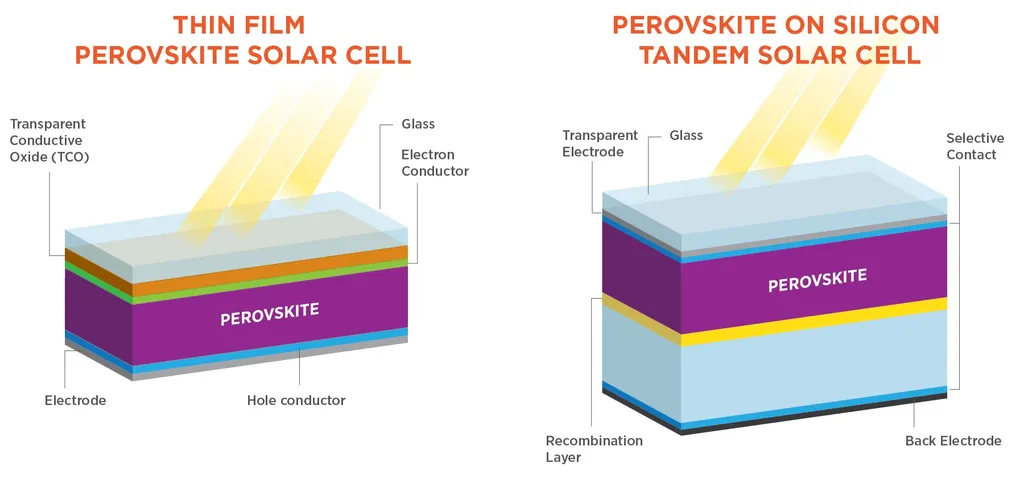
This week, the renewable energy sector witnessed a landmark achievement: researchers unveiled perovskite-silicon tandem solar cells capable of converting 34.6% of sunlight into electricity, a 57% improvement over traditional silicon panels. This breakthrough, announced by leading solar technology platforms and validated by independent labs, marks the most significant leap in solar efficiency in decades—positioning solar as the undisputed leader in the global transition to carbon-free energy.
The innovation lies in stacking perovskite and silicon cells, each optimized to capture different segments of the solar spectrum. Silicon cells, long the industry standard, max out at about 27% efficiency due to fundamental material limits. Perovskites, however, excel at absorbing higher-energy light, while silicon handles the lower-energy spectrum. By combining the two, researchers at the University of Manchester and other institutions have not only boosted efficiency but also demonstrated remarkable stability, with cells retaining over 95% performance after 1,100 hours of operation. This durability addresses a major hurdle for perovskites, which have historically struggled with rapid degradation under real-world conditions.
“This is a game-changer,” said Dr. Anita Ho-Baillie, a leading perovskite researcher. “We’re not just talking about incremental gains. At this efficiency, solar becomes the cheapest and most scalable solution for global decarbonization, even in regions with less sunlight.” The technology’s potential is further amplified by its compatibility with existing silicon production lines, reducing the barrier to industrial adoption.
The implications extend far beyond the lab. With renewable energy now generating 33% of global electricity and a projected $3.6 trillion market by 2030, perovskite-silicon tandems could accelerate the phase-out of fossil fuels in power grids worldwide. For policymakers, this means faster progress toward the 95% emissions reduction required to meet climate goals. For industry, it signals a shift from innovation to execution at scale—where the challenge is no longer if, but how quickly, these cells can be deployed.
As the world grapples with the dual demands of energy security and sustainability, this breakthrough offers a rare convergence of technical brilliance and practical promise. The race is now on to scale production, with pilot lines already underway and commercial rollout expected within the next two to three years. If successful, perovskite-silicon tandems could redefine not just solar energy, but the entire architecture of global power generation.