
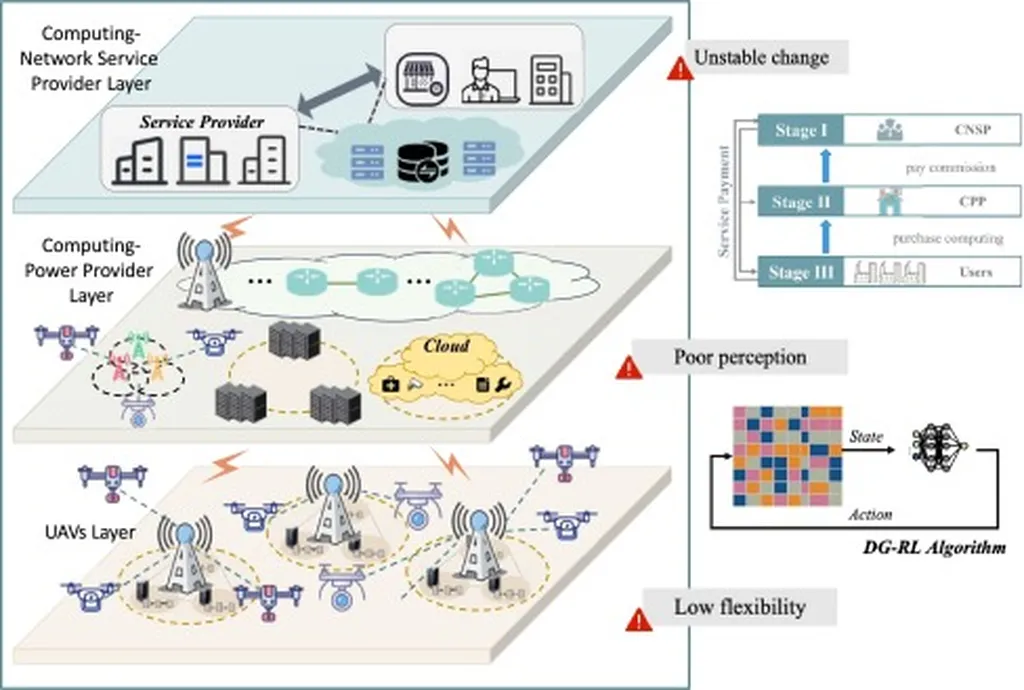
Researchers from the University of Florida, including Yiqin Deng, Zhengru Fang, Senkang Hu, Yanan Ma, Xiaoyu Guo, Haixia Zhang, and Yuguang Fang, have proposed a novel framework to enhance computing power by leveraging unmanned aerial vehicles (UAVs) in a concept they term UAV-enabled Computing Power Networks (UAV-CPNs). This research was published in the IEEE Internet of Things Journal.
The study introduces a system where UAVs act as dynamic relays, distributing computing tasks from areas with high demand to zones with more abundant computing resources. These resources can include vehicle onboard units, edge servers, and dedicated powerful nodes. By doing so, the framework aims to alleviate communication bottlenecks and mitigate the “island effect” in multi-access edge computing, where isolated networks have limited connectivity and resources.
One of the key challenges addressed in the research is quantifying the computing power performance under the complex dynamics of communication and computing. The researchers introduce the concept of task completion probability to measure the effectiveness of UAV-CPNs in handling computing tasks. They also enhance the performance of UAV-CPNs under a hybrid energy architecture by optimizing UAV altitude and transmit power. This dual-energy system, which includes fuel cells and batteries, powers both the UAV’s propulsion and communication systems.
The evaluations conducted by the researchers demonstrate significant performance gains, emphasizing the importance of balancing communication and computing capabilities, especially under dual-energy constraints. The findings highlight the potential of UAV-CPNs to substantially boost computing power, which could have practical applications in the energy sector. For instance, UAV-CPNs could enhance the monitoring and management of energy infrastructure, improve the efficiency of renewable energy integration, and support the development of smart grids by providing robust and flexible computing resources.
In summary, the research presents a promising approach to leveraging UAVs for enhancing computing power, with potential benefits for the energy industry in terms of improved infrastructure management and operational efficiency.
This article is based on research available at arXiv.