
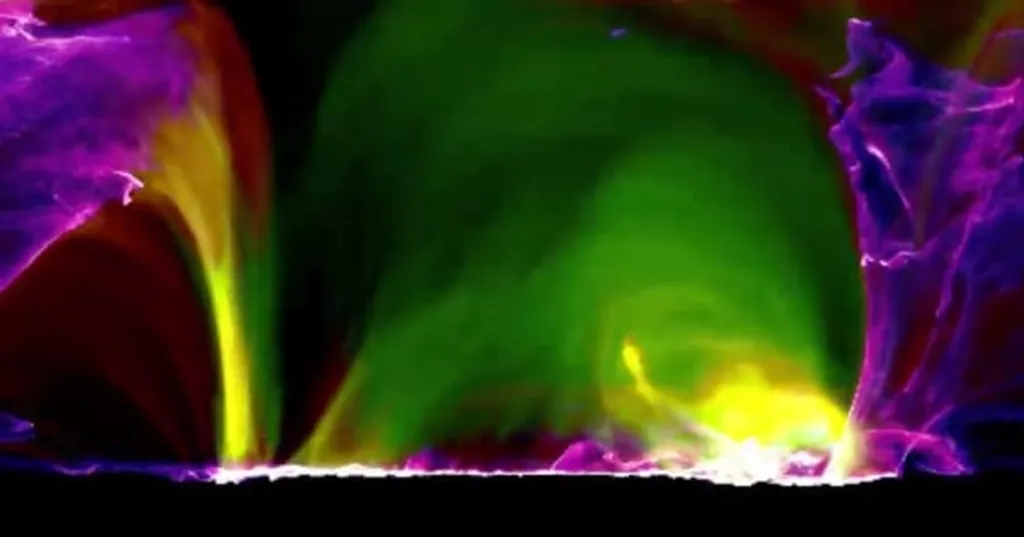
Researchers from the U.S. Naval Research Laboratory, including Lucas A. Tarr, N. Dylan Kee, James E. Leake, Mark G. Linton, and Peter W. Schuck, have made significant strides in simulating solar eruptions, a phenomenon that can greatly impact space weather and, consequently, energy infrastructure on Earth. Their work, published in the Astrophysical Journal, focuses on validating a data-driven magnetohydrodynamic (MHD) approach that could revolutionize our understanding of solar activity and its effects on the energy sector.
The team’s research centers around the development of a simulation model that accurately reproduces the dynamic emergence of solar active regions, the formation of key topological features in the corona, and the subsequent eruption of mass and magnetic field. This model is crucial for understanding the magnetic and plasma properties that lead to solar eruptions, which are currently difficult to infer from synoptic solar observations alone.
The researchers tested their boundary data-driven MHD approach against a larger, ab initio “Ground Truth” simulation that extends downward into the convection zone. The driven simulation accurately replicated the dynamics of the active region above the photosphere, demonstrating the model’s reliability. The total emerged energy matched to better than one percent, and the ratio of emerged to eruptive energy was approximately 2%. The actual values of each energy term agreed to within 10% between the two cases, indicating the high fidelity of the driven simulation.
One of the most significant aspects of this research is the data injection cadence. The model’s cadence matches the cadence of synoptic observations of the Sun’s surface magnetic field, which is three to four orders of magnitude longer than the inherent CFL time step of the simulations. This means the model can be driven using solar synoptic observations from existing and anticipated ground and space-based observatories, making it a practical tool for real-world applications.
For the energy sector, this research offers the potential for more accurate space weather forecasting. Solar eruptions can disrupt power grids, damage satellites, and interfere with radio communications. By better understanding and predicting these events, the energy industry can take proactive measures to protect infrastructure and ensure reliable energy delivery. The stability and fidelity of the code over an entire active region lifetime, from emergence to eruption, strongly suggest that this method will produce reliable results when driven using solar synoptic observations, providing a valuable tool for the energy sector to mitigate the impacts of space weather.
This article is based on research available at arXiv.