
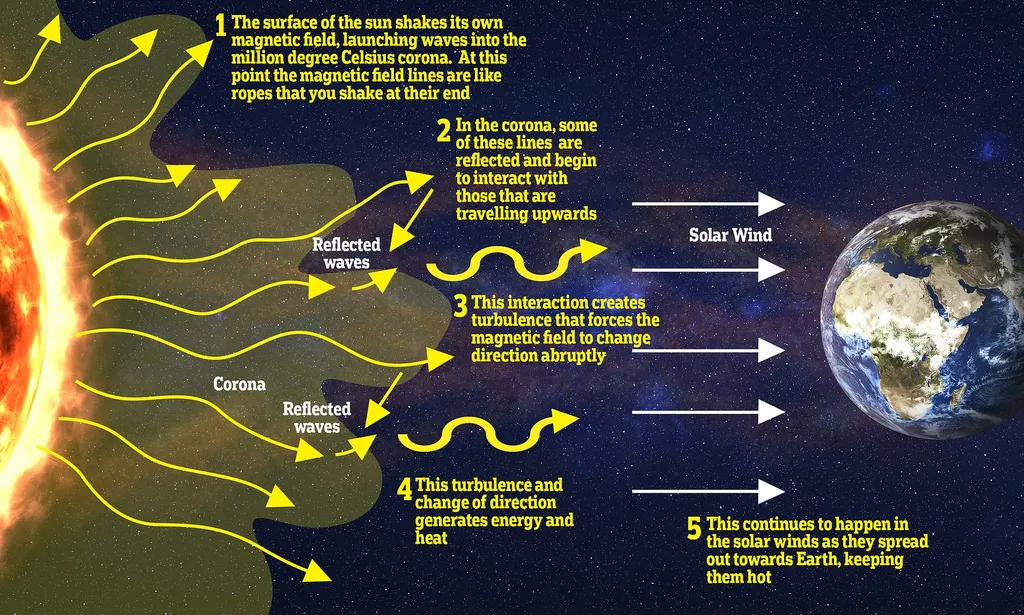
In the realm of solar and space physics, a team of researchers from KU Leuven, Belgium, and other international institutions, led by Haopeng Wang, has been delving into the intricacies of solar magnetic fields and their evolution. Their work, published in the journal Astronomy & Astrophysics, focuses on understanding the open magnetic flux around solar maximum, a period of intense solar activity.
The researchers utilized a series of hourly-updated magnetograms, which are maps of the solar magnetic field, to drive a coronal model named COCONUT. They preprocessed these magnetograms using different harmonic filters and configured the model with various heating prescriptions to mimic coronal evolutions during specific solar rotations. The goal was to evaluate the impact of temporal evolution, harmonic filtering, and oversimplified heating source terms on open-field distributions.
The study found that the simulated unsigned open flux near the solar surface can be comparable to that derived from interplanetary in situ observations. However, in the low corona, numerous small-scale closed-field magnetic structures introduce magnetic polarity inversion interfaces within the open field. This results in a cancellation of part of the open field near these interfaces, reducing the simulated unsigned open flux by up to 45% at 0.1 astronomical units (AU) and causing it to decrease more rapidly in the low corona.
The findings also indicate that moderate adjustments to the heating source term can effectively regulate the magnitude of the unsigned open magnetic flux. Preprocessing the initial magnetogram with a PF solver that uses limited spherical harmonics can reduce the open flux in the low corona and alter the distribution of open-field regions, but it has little effect on the total unsigned open flux at larger heliocentric distances. The ratio of the maximum to minimum open unsigned magnetic flux can reach 1.4 within a single solar maximum Carrington Rotation (CR), highlighting the dynamic nature of the solar magnetic field.
For the energy industry, particularly for space weather forecasting and solar power prediction, understanding these dynamics is crucial. Accurate modeling of solar magnetic fields can help predict solar flares and coronal mass ejections, which can impact satellite operations, power grids, and communication systems. The insights gained from this research can contribute to more precise space weather forecasts, enabling better preparation and mitigation strategies for potential solar-induced disruptions.
In summary, the research underscores the importance of considering finer grid resolution around magnetic polarity inversion interfaces, more realistic heating mechanisms, and the time-evolving regime of magnetohydrodynamic (MHD) coronal modeling. These factors are essential for addressing the “open flux problem” and improving our understanding of solar magnetic field evolution, which has practical applications in the energy sector, particularly in space weather forecasting and solar power prediction.
This article is based on research available at arXiv.