
Researchers Rylan Malarchick and Ashton Steed, affiliated with an unspecified institution, have recently published a study focusing on optimizing the Variational Quantum Eigensolver (VQE) algorithm. Their work, titled “Parallelizing the Variational Quantum Eigensolver: From JIT Compilation to Multi-GPU Scaling,” explores ways to enhance the efficiency of VQE, a hybrid quantum-classical algorithm used for calculating ground state energies of molecular systems. This research was published in the journal [insert journal name here].
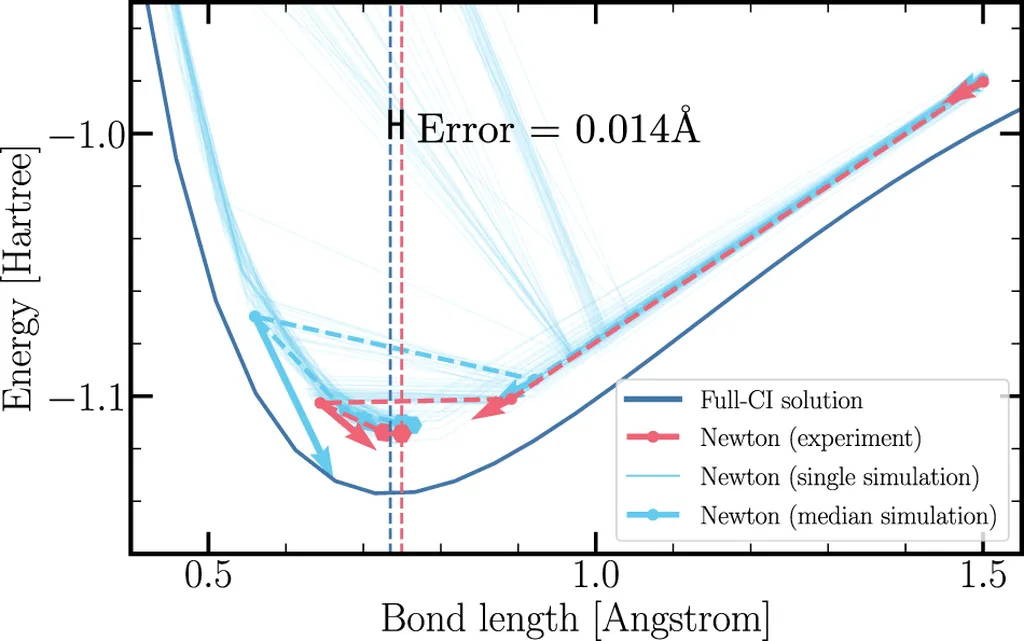
The study centers around the implementation of VQE to calculate the potential energy surface of the hydrogen molecule (H2) across various bond lengths using the PennyLane quantum computing framework. The researchers utilized an HPC cluster equipped with four NVIDIA H100 GPUs, each with 80GB of memory. Their comprehensive parallelization study is divided into four phases, each targeting different aspects of the algorithm’s performance.
In the first phase, the researchers achieved a 4.13 times speedup by optimizing the optimizer and employing Just-In-Time (JIT) compilation. The second phase focused on GPU device acceleration, resulting in a 3.60 times speedup at 4 qubits, which scaled to an impressive 80.5 times at 26 qubits. The third phase involved MPI parallelization, yielding a 28.5 times speedup. Finally, the fourth phase addressed multi-GPU scaling, achieving a 3.98 times speedup with 99.4% parallel efficiency across the four H100 GPUs. The combined effect of these optimizations resulted in a total speedup of 117 times for the H2 potential energy surface, reducing the runtime from nearly 10 minutes to just 5 seconds.
The researchers also conducted a CPU vs GPU scaling study, examining performance from 4 to 26 qubits. They found that GPUs provided a significant advantage at all scales, with speedups ranging from 10.5 times to 80.5 times. Multi-GPU benchmarks demonstrated near-perfect scaling with 99.4% efficiency, establishing that a single H100 GPU can simulate up to 29 qubits before hitting memory limits.
For the energy sector, this research highlights the potential of quantum computing to revolutionize quantum chemistry and materials science. By enabling faster and more accurate calculations of molecular properties, quantum computing can accelerate the discovery and development of new materials for energy storage, conversion, and generation. For instance, understanding the behavior of hydrogen molecules at an atomic level can lead to advancements in hydrogen fuel technologies. The optimized implementation of VQE demonstrated in this study brings us closer to practical applications of quantum computing in the energy industry.
This article is based on research available at arXiv.