
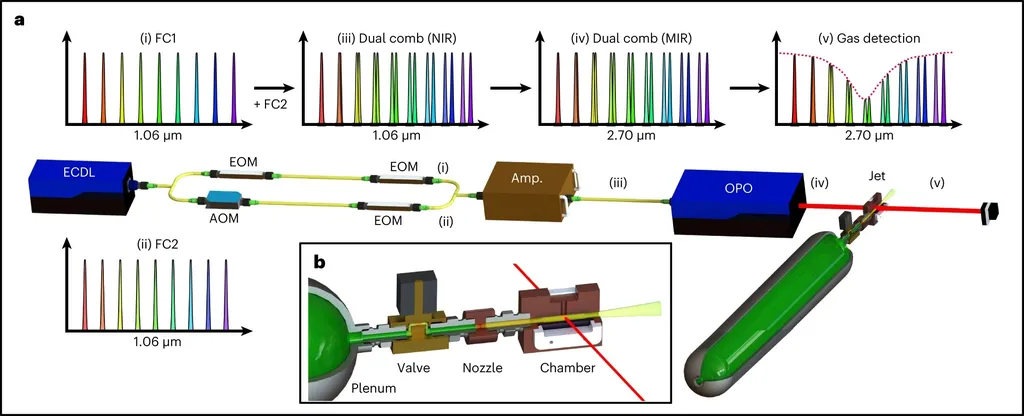
Researchers from the Physical Measurement Laboratory at the National Institute of Standards and Technology (NIST) have developed a novel approach to Doppler thermometry that could have significant implications for various industries, including energy. The team, led by Sean M. Bresler and including Erin M. Adkins, Stephen P. Eckel, Tobias K. Herman, David A. Long, Benjamin J. Reschovsky, and Daniel S. Barker, has published their findings in the journal Optica.
The researchers have demonstrated a new type of Doppler thermometer that uses a chirped electro-optic frequency comb (EOFC) to measure the temperature of an rubidium vapor with high accuracy. The EOFC Doppler thermometer is accurate to within approximately 1 Kelvin, and the team has shown that it can mitigate transit-induced optical pumping distortion of the atomic lineshape, which is a common source of systematic temperature shift in traditional Doppler thermometry methods.
In their study, the researchers compared direct EOFC spectroscopy with conventional Doppler spectroscopy using a single-frequency, step-scanned laser probe. They found that the EOFC approach was able to use higher optical power to reduce statistical noise without causing optical pumping distortion. This means that the EOFC Doppler thermometer can provide more accurate and reliable temperature measurements, even in challenging environments.
The researchers also conducted simulations using the optical Bloch equations to confirm their experimental results. These simulations showed that direct EOFC spectroscopy can indeed reduce statistical noise and mitigate optical pumping distortion, making it a promising approach for a wide range of applications.
One potential application of this technology is in the energy sector, particularly in nuclear waste monitoring. Accurate temperature measurements are critical for ensuring the safe and efficient disposal of nuclear waste, and the EOFC Doppler thermometer could provide a reliable and precise way to monitor temperature in these environments. Additionally, the technology could be useful in other high-temperature industrial processes, such as pharmaceutical manufacturing and chemical processing.
Overall, the development of the EOFC Doppler thermometer represents an important advancement in the field of temperature measurement. The researchers’ findings suggest that this technology has the potential to improve the accuracy and reliability of temperature measurements in a wide range of applications, including those in the energy sector. The research was published in the journal Optica, and the full study can be found here.
This article is based on research available at arXiv.