
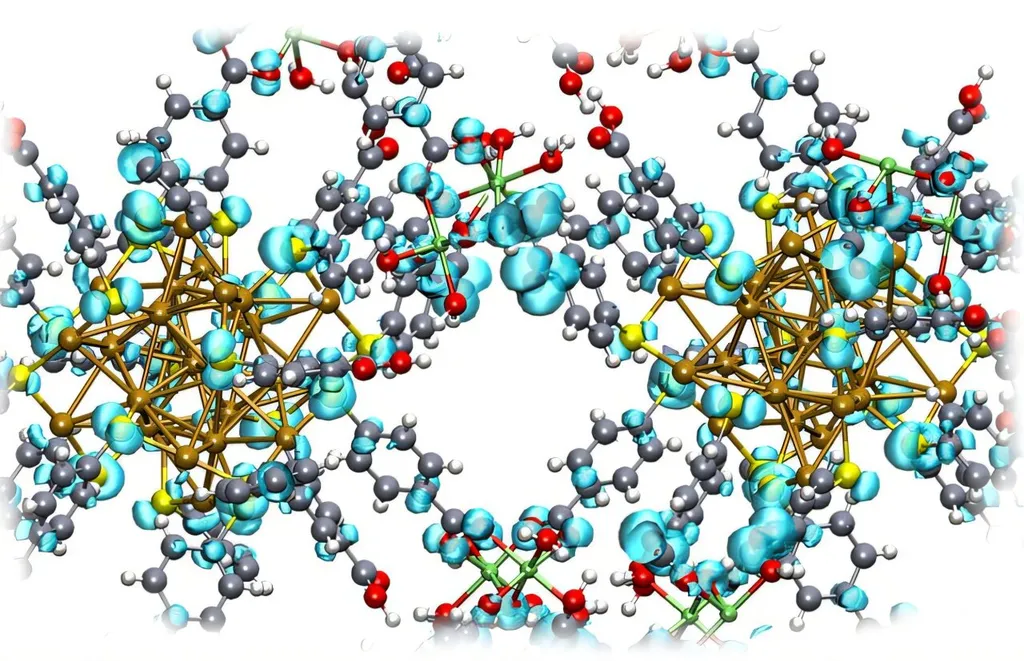
Researchers from the University of Basel, including Ehsan Rahmatizad Khajehpasha, Mohammad Ismaeil Safa, Nasrin Eyvazi, Marco Krummenacher, and Stefan Goedecker, have conducted a study on the structural transformations of gold nanoclusters. Their work, published in the journal “Nano Letters,” sheds light on the intricate processes that occur at the nanoscale, which could have significant implications for the energy industry.
Gold nanoclusters, which are tiny particles of gold containing a specific number of atoms, can exist in various structural forms with similar energy levels. This allows them to coexist and transform between different shapes. The researchers used advanced computational techniques to investigate the transformation pathways between three specific structures: cuboctahedra, Ino’s decahedra, and icosahedra, for nanoclusters containing 55, 147, 309, and 561 gold atoms.
The team employed a high-accuracy machine-learned potential, trained on a vast amount of data from density functional theory calculations, to explore these transformations. Their findings revealed that high-symmetry transformations from cuboctahedra and Ino’s decahedra to icosahedra occur through a single energy barrier and involve specific types of atomic motions. Additionally, they discovered lower-energy pathways that lead to disordered, or amorphous, icosahedral structures.
The researchers also identified new global minima for the Au309 and Au561 nanoclusters, which have energies up to 2.8 electron volts lower than previously reported. This suggests that the shapes and transformation pathways studied in earlier investigations may not be the most physically relevant. The newly identified pathways provide transformation times that align more closely with experimental observations.
The practical applications of this research for the energy industry are manifold. Understanding the structural transformations of gold nanoclusters can aid in the development of more efficient catalysts for energy conversion and storage. Gold nanoclusters are known for their unique catalytic properties, and their ability to transform between different structures could enhance their performance in applications such as fuel cells, solar cells, and batteries. Additionally, the insights gained from this study could contribute to the design of new nanomaterials with tailored properties for energy-related applications.
In conclusion, the research conducted by the team at the University of Basel provides valuable insights into the transformation mechanisms of gold nanoclusters. Their findings not only advance our fundamental understanding of nanoscale phenomena but also pave the way for innovative applications in the energy sector.
This article is based on research available at arXiv.