
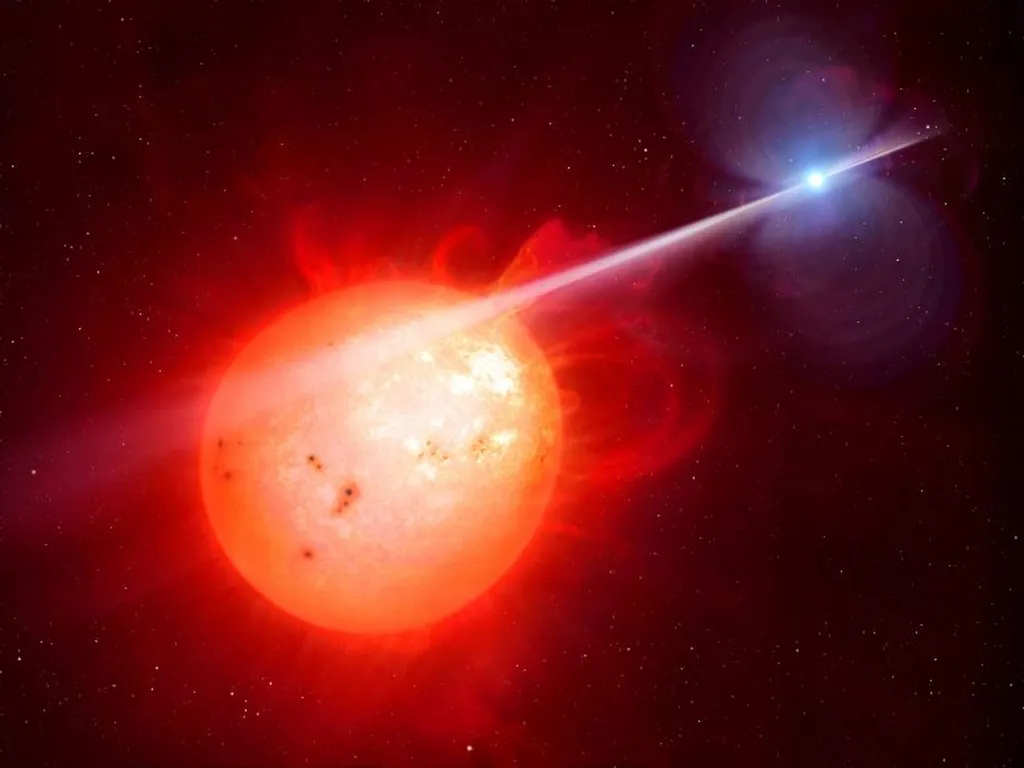
In the realm of astrophysics and energy research, the study of binary pulsars offers unique insights into the dynamics of extreme environments, which can have implications for our understanding of energy processes in the universe. Ali Taani, a researcher affiliated with the University of Jordan, has delved into the complex dynamics of non-synchronous binary pulsars, shedding light on the interplay between general relativity, stellar structure, and tidal interactions.
Taani’s study, published in the journal Astronomy & Astrophysics, focuses on the apsidal motion of three binary pulsars: PSR 1913+16, PSR J0737-3039A/B, and PSR J0621+1002. Apsidal motion refers to the rotation of the major axis of an orbit, and its study provides a valuable probe into the relativistic and tidal effects that govern the evolution of close binary systems. Using Zahn’s tidal equations, Taani conducted numerical integrations to describe the tidal effects and their role in the orbital and spin evolution of these systems.
The research reveals that tidal effects play a minor role in the orbital decay of these binary pulsars compared to the energy loss due to gravitational wave emission. For instance, in the compact system PSR 1913+16, the orbital period decreases by approximately 76.5 microseconds per year primarily due to gravitational radiation. The double pulsar J0737-3039A/B exhibits faster orbital evolution, with synchronization occurring in about 8,400 years. In contrast, the wider system J0621+1002 shows negligible orbital change over timescales exceeding 10 billion years.
The simulations conducted by Taani demonstrate clear trends of decreasing semi-major axis and eccentricity, accompanied by an increase in spin rate among the binary pulsars studied. The derived apsidal motion constants are consistent with theoretical expectations, and the corresponding tidal friction times range from a few hours to several days, aligning well with theoretical predictions. These findings underscore the dominant role of relativistic effects in the evolution of neutron star binaries and highlight the importance of including gravitational-wave terms in long-term orbital evolution models.
For the energy sector, understanding the dynamics of binary pulsars and the role of gravitational waves can provide insights into the fundamental processes that govern energy transfer and dissipation in extreme astrophysical environments. While the direct practical applications to energy technologies may be limited, the study of these phenomena contributes to our broader knowledge of the universe and the laws of physics that underpin energy processes.
This article is based on research available at arXiv.